Squeezed states of light representation for negative R
In the study of quantum optics, squeezed states of light present a fascinating departure from classical descriptions. By manipulating quantum fluctuations, these states exhibit reduced noise in one quadrature of the electromagnetic field at the expense of increased noise in the other. This unique characteristic has significant implications for precision measurements and quantum information processing.
To understand the behavior of squeezed states, I consider a fixed position in space, \mathbf r = \mathbf 0, for simplicity. The variance of the electric field fluctuations, \Delta E_{\lambda}(\mathbf r,t), for a specific mode \lambda can be expressed as:
\left(\Delta E_{\lambda}(\mathbf 0,t)\right)^2 = \left[\mathscr{E}_{\lambda}^{(1)} \right]^2 \left( e^{2 R_\lambda} \cos^2\left( - \omega_{\lambda} t \right) + e^{-2 R_\lambda} \sin^2\left( - \omega_{\lambda} t \right) \right)
where R_\lambda is the squeezing parameter and \mathscr{E}_{\lambda}^{(1)} is the electric field amplitude of a single photon. This equation reveals that for certain values of R_\lambda and time t, the variance can be less than \left[\mathscr{E}_{\lambda}^{(1)} \right]^2, the variance of a coherent state, which is often considered a quasi-classical state.
Let’s examine the case where R_\lambda < 0. For simplicity, I also assume the amplitude \alpha_\lambda is real, leading to \alpha_\lambda^\prime = \alpha_{\lambda R} e^{-R_\lambda} \in \mathbb R. The average electric field then evolves as:
\begin{aligned} \langle \boldsymbol \alpha_\lambda, R_\lambda | \mathbf{E}_{\lambda}(\mathbf 0,t) | \boldsymbol \alpha_\lambda, R_\lambda \rangle & = -2i\mathscr{E}_{\lambda}^{(1)} \alpha_\lambda^\prime\sin(-i\omega t) \end{aligned}
Visualizing this in the complex plane provides valuable insight. For quasi-classical states, the electric field dispersion is represented by a disk. However, for squeezed states, this dispersion takes the form of a rotating ellipse.This ellipse’s major axis is expanded, and its minor axis is compressed compared to the classical disk, reflecting the squeezing effect.
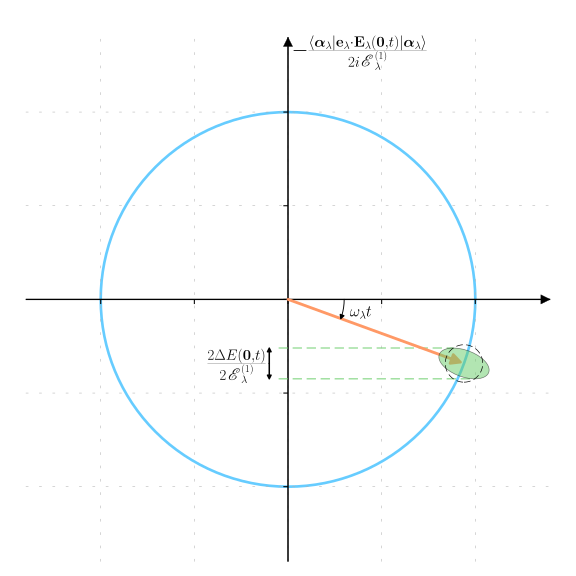
The orientation of this ellipse rotates with time, leading to a modulation of the dispersion when projected onto a specific axis, such as the imaginary axis representing the electric field. The maximum dispersion is \Delta E_{max} = \mathscr{E}_{\lambda}^{(1)} e^{R_\lambda}, and the minimum dispersion is \Delta E_{min} = \mathscr{E}_{\lambda}^{(1)} e^{-R_\lambda}. Importantly, their product:
\Delta E_{max}\cdot \Delta E_{min} = \left[\mathscr{E}_{\lambda}^{(1)}\right]^2
remains constant and equal to the minimum uncertainty allowed by the Heisenberg principle. This confirms that while squeezed states reduce noise in one quadrature, they do so while adhering to the fundamental limits of quantum mechanics. My analysis highlights the unique nature of squeezed states and their potential for applications requiring enhanced precision.
For more insights into this topic, you can find the details here.