Squeezed states of light representation for positive R
In my previous post here, I explored squeezed states of light with a negative squeezing parameter R_\lambda < 0. Now, I will continue by examining the case of positive squeezing, R_\lambda > 0. Understanding both positive and negative squeezing is necessary for a complete picture of these quantum states.
As before, the variance of the electric field fluctuations is given by:
\left(\Delta E_{\lambda}(\mathbf 0,t)\right)^2 = \left[\mathscr{E}_{\lambda}^{(1)} \right]^2 \left( e^{2 R_\lambda} \cos^2\left( - \omega_{\lambda} t \right) + e^{-2 R_\lambda} \sin^2\left( - \omega_{\lambda} t \right) \right)
However, with R_\lambda > 0, the behavior of the dispersion changes. In this case, the standard deviation of the electric field is maximized when \omega t = 0, 2\pi, ... and minimized when \omega t = \pi/2, 3\pi/2, .... This is in contrast to the R_\lambda<0 case, where the opposite behavior was observed.
In the complex plane, this behavior is again represented by a rotating ellipse. The key difference for R_\lambda > 0 is the orientation of this ellipse. Here, the ellipse’s long axis is tangent to the rotation path, while its short axis is radial. Projecting this rotating ellipse onto the imaginary axis reveals the time evolution of the field average and its dispersion.
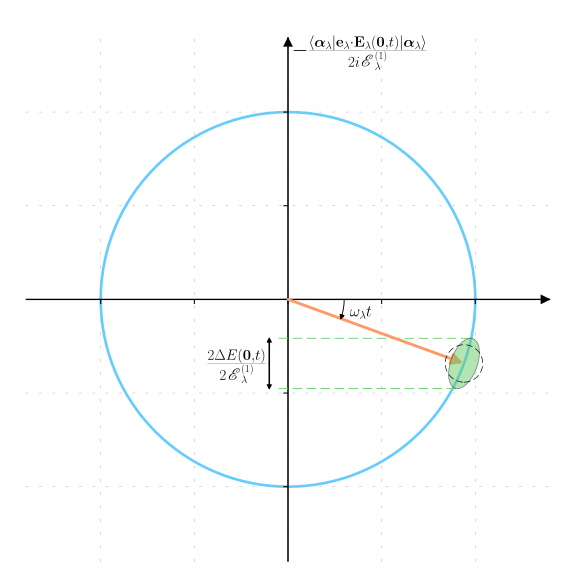
Despite the change in orientation and the times at which maximum and minimum dispersion occur, the product of the maximum and minimum dispersions still reaches the Heisenberg limit:
\Delta E_{max}\cdot \Delta E_{min} = \left[\mathscr{E}_{\lambda}^{(1)}\right]^2
This confirms that regardless of the sign of R_\lambda, squeezed states remain minimum uncertainty states, achieving noise reduction in one quadrature at the expense of increased noise in the other, always respecting the fundamental limits of quantum mechanics.
For more insights into this topic, you can find the details here.