Measuring with a Mach-Zehnder interferometer
Optical interferometers are essential tools in precision measurement, with gravitational wave detectors being a prominent example. Laser shot noise limits their sensitivity, but squeezed light offers a way to overcome this limitation. While advanced interferometers are used in gravitational wave observatories, a Mach-Zehnder interferometer provides a clear picture of how squeezed light can improve sensitivity.
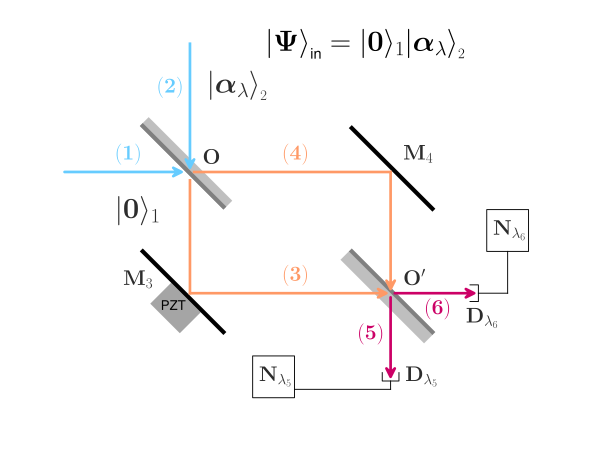
Let’s consider a Mach-Zehnder interferometer. A laser beam, represented as a quasi-classical state | \boldsymbol \alpha_\lambda \rangle, enters input port (2), while vacuum enters input port (1). The input state is described as:
| \boldsymbol \Psi_{\text{in}} \rangle = | \mathbf 0 \rangle_1 \otimes | \boldsymbol \alpha_{\lambda} \rangle_2
This is similar to a balanced homodyne detection setup. We aim to calculate the photon counts at the output ports (5) and (6), denoted as \mathbf N_5 and \mathbf N_6. The average photon number in the input channel (2) is |\alpha_\lambda|^2.
Using beam splitter matrices for the two beam splitters BS_1 and BS_2, and considering phase shifts e^{ikL_3} and e^{ikL_4} in the interferometer arms, we can derive the annihilation operators for the output modes, \mathbf a_{\lambda_6} and \mathbf a_{\lambda_5}. After going through the transformations from the first beam splitter, phase shifts, and the second beam splitter, and defining the phase difference \delta = k(L_3 - L_4), the output operators are:
\begin{aligned} \mathbf a_{\lambda_6} & = e^{ik \frac{(L_3+L_4)}{2}} \left[ \mathbf a_{\lambda_1} \cos\left(\frac{\delta}{2}\right) + i\mathbf a_{\lambda_2} \sin\left(\frac{\delta}{2}\right) \right] \\ \mathbf a_{\lambda_5} & = e^{ik \frac{(L_3+L_4)}{2}} \left[ -i\mathbf a_{\lambda_1} \sin\left(\frac{\delta}{2}\right) - \mathbf a_{\lambda_2} \cos\left(\frac{\delta}{2}\right) \right] \end{aligned}
By computing the expectation values of the photon number operators \mathbf N_{\lambda_6} = \mathbf a_{\lambda_6}^\dag \mathbf a_{\lambda_6} and \mathbf N_{\lambda_5} = \mathbf a_{\lambda_5}^\dag \mathbf a_{\lambda_5} with respect to the input state | \boldsymbol \Psi_{\text{in}} \rangle, we find the average photon counts at the output ports:
\begin{aligned} \langle \mathbf N_{\lambda_6} \rangle & = | \alpha_{\lambda}|^2 \sin^2\left(\frac{\delta}{2}\right) \\ \langle \mathbf N_{\lambda_5} \rangle & = |\alpha_{\lambda}|^2 \cos^2\left(\frac{\delta}{2}\right) \end{aligned}
These results show that the number of photons detected at each output port varies sinusoidally with the phase difference \delta. This phase difference, which depends on the lengths of the interferometer arms, can be controlled, for example, using a piezoelectric transducer on mirror \mathbf M_3. This modulation allows for the measurement of phase shifts and forms the basis for interferometric sensing.
For more insights into this topic, you can find the details here.