Quadrature measurement with vacuum
In quantum optics, one approach to measure a quadrature component involves using a balanced beam splitter. Let’s consider a scenario where we have two input channels. In channel (1), we have an arbitrary quantum state |\boldsymbol \psi \rangle_1, and in channel (2), we introduce a quasi-classical state |\boldsymbol \alpha_\lambda \rangle_2, where \alpha_\lambda is a real number. This quasi-classical state with a real coefficient, simplifies the analysis while still providing valuable insights.
The difference in photon numbers at the output of a beam splitter, denoted as \mathbf N_{\lambda_6} - \mathbf N_{\lambda_5}, can be expressed in terms of the input annihilation and creation operators \mathbf a_{\lambda_i} and the beam splitter angle \varepsilon:
\mathbf N_{\lambda_6} - \mathbf N_{\lambda_5} = -\sin(\varepsilon) \left( \mathbf a_{\lambda_1}^\dag \mathbf a_{\lambda_1} - \mathbf a_{\lambda_2}^\dag \mathbf a_{\lambda_2} \right) + i \cos(\varepsilon) \left( \mathbf a_{\lambda_1}^\dag \mathbf a_{\lambda_2} - \mathbf a_{\lambda_2}^\dag \mathbf a_{\lambda_1} \right)
To understand what this measurement reveals about the input state in channel (1), we can compute the expectation value of this difference assuming the state in channel (2) is the quasi-classical state |\boldsymbol \alpha_\lambda \rangle_2.
For the specific case of a balanced beam splitter, where \varepsilon = 0, the expression simplifies significantly. The expectation value becomes:
{}_2 \langle \boldsymbol \alpha_\lambda | \mathbf N_{\lambda_6} - \mathbf N_{\lambda_5}| \boldsymbol \alpha_\lambda \rangle_2 = i \alpha_{\lambda_2} \left( \mathbf a_{\lambda_1}^\dag - \mathbf a_{\lambda_1} \right)
Recognizing the definition of the momentum quadrature operator \mathbf P_{\lambda_1} = \sqrt{\frac{\hbar}{2}}i (\mathbf a_{\lambda_1}^\dag - \mathbf a_{\lambda_1}), we find that the expectation value is proportional to the \mathbf P_{\lambda_1} quadrature of the input state in channel (1):
{}_2 \langle \boldsymbol \alpha_\lambda | \mathbf N_{\lambda_6} - \mathbf N_{\lambda_5}| \boldsymbol \alpha_\lambda \rangle_2 = \alpha_{\lambda_2} \sqrt{\frac{2}{\hbar}} \mathbf P_{\lambda_1}
This result indicates that measuring the difference in photon numbers in this configuration effectively measures the \mathbf P_{\lambda_1} quadrature of the field in input channel (1), scaled by a factor related to the amplitude of the quasi-classical state in channel (2).
Furthermore, by analyzing the variance of the balanced signal, we can gain insight into the fluctuations of this quadrature. For \varepsilon = 0 and a strong quasi-classical state (large \alpha_{\lambda_2}), the variance of the photon number difference is approximately:
\langle \boldsymbol \Psi_{\text{in}} |\left(\Delta_{\mathbf N_{\lambda_6} - \mathbf N_{\lambda_5}}\right)^2 | \boldsymbol \Psi_{\text{in}} \rangle \approx \alpha_{\lambda_2}^2 \frac{4}{\hbar} \langle \mathbf P_{\lambda_1}^2 \rangle
This shows that the variance is also related to the variance of the \mathbf P_{\lambda_1} quadrature of the input state in channel (1).
Consider the scenario where input channel (1) is in the vacuum state | \mathbf 0 \rangle. In this case, the measurement reflects the vacuum fluctuations of the \mathbf P_{\lambda_1} quadrature:
\begin{aligned} & \langle \boldsymbol \Psi_{\text{in}} |\left(\Delta_{\mathbf N_{\lambda_6} - \mathbf N_{\lambda_5}}\right)^2 | \boldsymbol \Psi_{\text{in}} \rangle = \alpha_{\lambda_2}^2 \frac{2}{\hbar} \langle \mathbf 0 | \mathbf P_{\lambda_1}^2 | \mathbf 0 \rangle \\ & \langle \boldsymbol \Psi_{\text{in}} | \Delta_{\mathbf N_{\lambda_6} - \mathbf N_{\lambda_5}} | \boldsymbol \Psi_{\text{in}} \rangle = \alpha_{\lambda_2}^2 \sqrt{\frac{2}{\hbar}} \langle \mathbf 0 | \mathbf P_{\lambda_1} | \mathbf 0 \rangle = 0 \end{aligned}
This can be visualized in the complex plane representation of vacuum quadratures, where vacuum fluctuations are uniformly distributed in phase.
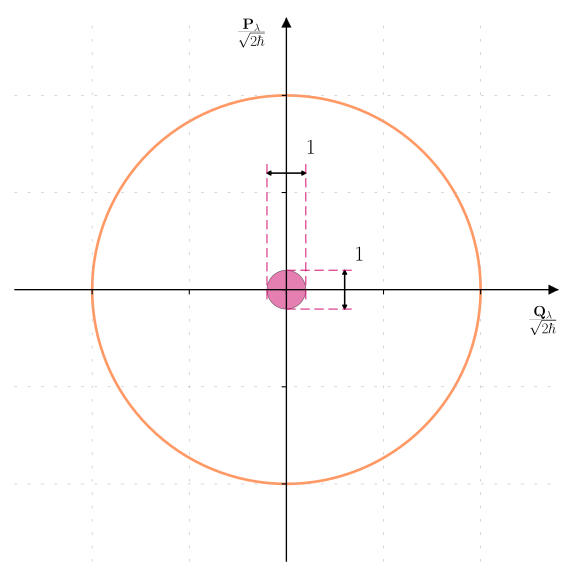
In conclusion, using a balanced Mach-Zehnder interferometer with a strong quasi-classical state in one input channel enables the measurement of the \mathbf P_{\lambda_1} quadrature of the quantum state in the other input channel. This technique provides a practical way to explore quantum statistical properties and quadrature fluctuations.
For more insights into this topic, you can find the details here.