Single photon polarization
In classical electromagnetism, polarization describes the orientation of the electric field vector of a light wave. When we move into the quantum optics and consider light as individual photons, the concept of polarization takes on a quantum mechanical description. In this post, I will explore how polarization is understood for a single photon.
Starting from the classical description of an electromagnetic field as a sum of independent modes, we can focus on a single mode characterized by a wave vector \mathbf k. The electric field associated with this mode is perpendicular to \mathbf k and can be decomposed into two orthogonal polarization directions, say along \mathbf x and \mathbf y axes.
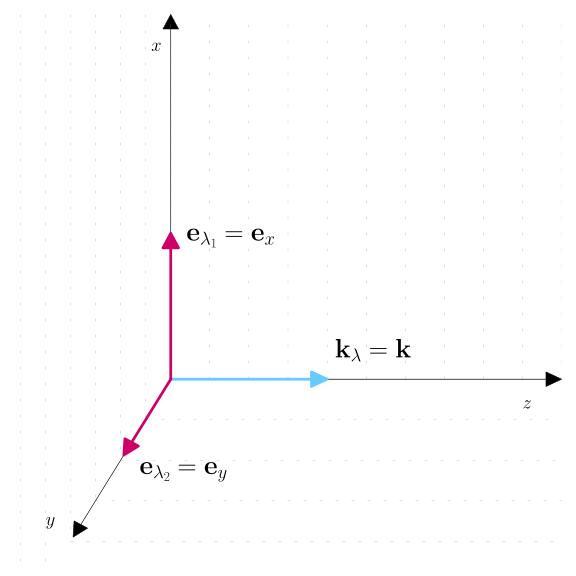
Quantum mechanically, we describe these polarization modes using number states. A state |\mathbf n_x, \mathbf n_y\rangle represents a state with n_x photons in the x-polarized mode and n_y photons in the y-polarized mode. The most general quantum state is a superposition of these number states.
For simplicity, let’s consider the case of one-photon polarization. We are interested in states with a single photon in either the x or y polarization mode, or a superposition of both. We can represent a general one-photon polarization state as:
| \boldsymbol \Psi^{(1)} \rangle = \alpha |\mathbf 1_x \rangle + \beta |\mathbf 1_y \rangle, \quad |\alpha|^2 + |\beta|^2 = 1
Here, |\mathbf 1_x \rangle represents a single photon polarized along the x-axis, and |\mathbf 1_y \rangle represents a single photon polarized along the y-axis. \alpha and \beta are complex coefficients that determine the superposition, with the normalization condition |\alpha|^2 + |\beta|^2 = 1 ensuring that the state is properly normalized.
This one-photon state is an eigenstate of the number operator \mathbf N = \mathbf a_x^\dag \mathbf a_x + \mathbf a_y^\dag \mathbf a_y.
Just as a classical polarization at an angle \theta can be decomposed into x and y components, a quantum state representing polarization at an angle \theta is given by:
|\mathbf 1_\theta\rangle = \cos \left(\theta\right) |\mathbf 1_x\rangle + \sin \left(\theta\right) |\mathbf 1_y\rangle
This state describes a single photon with linear polarization at an angle \theta relative to the x-axis. The two-dimensional state space spanned by |\mathbf 1_x\rangle and |\mathbf 1_y\rangle provides a quantum analogue to the classical polarization vector space.
For more insights into this topic, you can find the details here.