Entangled photon pairs
Entangled photon pairs offer an easy for studying quantum entanglement. Their simplicity, being analogous to spin one-half systems, allows for clear demonstrations of entanglement principles, especially within quantum optics. Experimentally, entangled photons are readily generated and manipulated, making them widely used for quantum experiments and protocols, unlike other quantum systems.
A typical experimental setup involves a source emitting two photons, \nu_1 and \nu_2, traveling in opposite directions. Polarization measurements are then performed on each photon using polarizers oriented at angles \alpha and \beta.
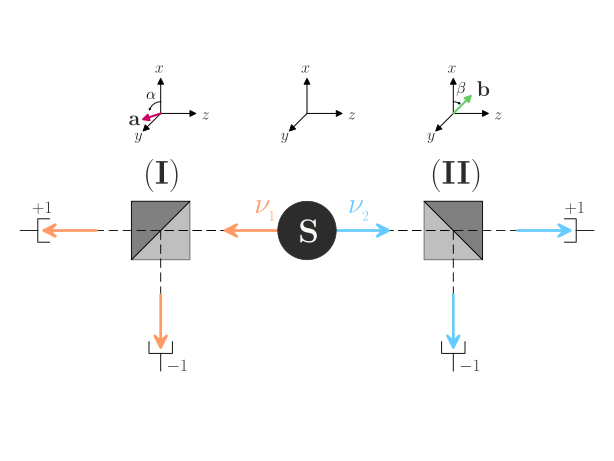
The entangled state of the photon pair is described by:
| \boldsymbol \Psi \left( \nu_1, \nu_2 \right) \rangle = \frac{1}{\sqrt{2}} \left(| \mathbf x_1, \mathbf x_2\rangle + |\mathbf y_1, \mathbf y_2\rangle\right)
This state is particularly interesting because it cannot be written as a product of individual states for photon 1 and photon 2. To see this, consider a general product state:
|\boldsymbol \Psi \rangle = (\gamma |\mathbf x_1\rangle + \lambda |\mathbf y_1\rangle) \otimes (\mu |\mathbf x_2\rangle + \nu |\mathbf y_2\rangle)
If we expand this, we get terms like |\mathbf x_1, \mathbf y_2\rangle and |\mathbf y_1, \mathbf x_2\rangle. However, our entangled state has no such terms. For the product state to match the entangled state, certain coefficients must be zero, leading to a contradiction when we try to match the non-zero terms |\mathbf x_1, \mathbf x_2\rangle and |\mathbf y_1, \mathbf y_2\rangle. This impossibility of factorization is the defining feature of entanglement.
We can measure the polarization of each photon. For a polarizer oriented along a direction \mathbf a, the possible outcomes are polarization along | \boldsymbol \varepsilon_\alpha \rangle (denoted as +1) or orthogonal polarization (-1). These polarization states are given by:
| \boldsymbol +_{\mathbf a} \rangle = | \boldsymbol \varepsilon_\alpha \rangle = \cos\left(\alpha\right) | \mathbf x \rangle + \sin\left(\alpha\right) | \mathbf y \rangle
| \boldsymbol -_{\mathbf a} \rangle = | \boldsymbol \varepsilon_{\alpha + \pi/2} \rangle = -\sin\left(\alpha\right) | \mathbf x \rangle + \cos\left(\alpha\right) | \mathbf y \rangle
Similarly, for another polarizer along \mathbf b, we have analogous polarization states | \boldsymbol +_{\mathbf b} \rangle and | \boldsymbol -_{\mathbf b} \rangle.
The study of entangled photon pairs provides a clear and experimentally accessible route to understanding the fundamental aspects of quantum entanglement and its applications in quantum technologies.
For more insights into this topic, you can find the details here.