Correlations in entangled photon pairs
In my previous posts (here and here) I’ve shown that individual polarization measurements appear random, each outcome having a probability of 1/2. However, the true nature of entanglement is revealed when we examine the correlations between joint measurements.
Let’s consider the case where the polarizers are parallel, meaning the angle difference \alpha - \beta = 0. In this scenario, the joint probabilities are:
\begin{aligned} & \mathcal P_{++}(0) = \frac{1}{2} \\ & \mathcal P_{--}(0) = \frac{1}{2} \\ & \mathcal P_{+-}(0) = 0 \\ & \mathcal P_{-+}(0) = 0 \end{aligned}
These probabilities indicate a perfect correlation. If I measure +1 for photon \nu_1, we are guaranteed to measure +1 for photon \nu_2. The conditional probability \mathcal P(+_{\nu_2} \mid +_{\nu_1}) = 1 confirms it.
To quantify the correlation for arbitrary polarizer angles, I use the correlation coefficient \mathcal C. For polarization measurements, it simplifies to:
\mathcal C = \overline{AB} = (\mathcal P_{++}(\mathbf a, \mathbf b) + \mathcal P_{--}(\mathbf a, \mathbf b)) - (\mathcal P_{+-}(\mathbf a, \mathbf b) + \mathcal P_{-+}(\mathbf a, \mathbf b))
For parallel polarizers (\alpha - \beta = 0), the correlation coefficient is:
\mathcal C = \left(\frac{1}{2} + \frac{1}{2}\right) - (0 + 0) = 1
This value of \mathcal C = 1 signifies perfect positive correlation.
For a general angle difference (\alpha - \beta), the correlation coefficient is:
\mathcal C(\alpha, \beta) = \cos(2(\alpha - \beta))
When the polarizers are orthogonal (\alpha - \beta = \pi/2), the correlation coefficient becomes:
\mathcal C = \cos(\pi) = -1
\mathcal C = -1 indicates perfect anti-correlation. If we measure +1 for photon \nu_1, we are certain to measure -1 for photon \nu_2.
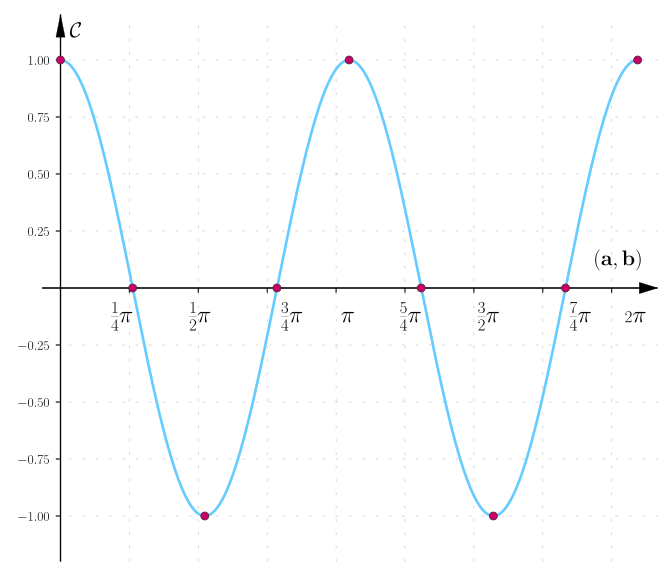
The correlation coefficient \mathcal C = \cos(2(\alpha - \beta)) demonstrates the angular dependence of entanglement correlations, ranging from perfect positive correlation (\mathcal C=1) to perfect anti-correlation (\mathcal C=-1) as the relative angle between polarizers changes.
For more insights into this topic, you can find the details here.