Thinking, Fast and Slow
Daniel Kahneman “Thinking, fast and slow” presents a comprehensive exploration of the human mind, explaining how two distinct systems dictate our thoughts and actions. System 1 operates automatically and intuitively, with little or no effort and no sense of voluntary control. In contrast, System 2 allocates attention to effortful mental activities, including complex computations.
Our reliance on heuristics can lead to cognitive biases, causing irrational decisions. We often have the illusion of understanding and are overconfident. By recognizing the limitations of our intuitive judgments, it is possible to distinguish when we can trust our instincts and when to engage in rigorous analysis. The book is trying to equip individuals with the tools needed to navigate complex choices, and improve their overall reasoning skills across personal and professional environments.
System 1 as an Associative Machine
System 1: Characteristics and Limitations
Two systems of thinking
Psychologists identify two distinct modes of mental operation, labeled System 1 and System 2.
System 1 operates automatically and rapidly, demanding little to no conscious effort. It runs in the background without any sense of deliberate control, handling the bulk of our moment-to-moment mental activity: recognizing faces, reading familiar words, detecting the mood in someone’s voice, or reacting instinctively to a sudden noise.
System 2, by contrast, is the slower, more deliberate partner. It steps in to allocate attention and cognitive resources to tasks that require effort, such as following a complex argument, working through a mathematical problem, or carefully weighing a difficult decision.
When we reflect on what it means to “think”, we tend to identify with System 2, the conscious, reasoning self that feels in charge. In practice, however, both systems are active whenever we are awake. System 1 runs continuously and almost silently, keeping System 2 in a relatively relaxed, low-effort state for most of the day. At the same time, System 1 passes a steady stream of suggestions to System 2, in the form of impressions, intuitions, and emotional signals. System 2, in turn, typically endorses these signals and translates them into actions, often without much scrutiny or modification.
It is only when System 1 encounters a situation it cannot handle on its own, one that falls outside its repertoire of familiar patterns, that it calls on System 2 for focused attention and deliberate reasoning.
This division of labor is efficient under most circumstances. System 1 excels at pattern recognition, allowing us to navigate a complex world quickly and with minimal mental strain. The downside, however, is that this speed comes at a cost: System 1 is inherently prone to systematic biases. It also operates at a level too deep and too automatic to be simply switched off. As a result, its biases can surface even when System 2 is engaged, creating a persistent tension between our instinctive responses and our reasoned judgments.
Attention and effort
The relationship between mental effort and the body is detectable: when people concentrate on demanding tasks, their pupils dilate, providing researchers with a physiological window into cognitive load. By monitoring pupil size, it is possible to tell whether someone is engaged in a System 2 activity or whether their mind has drifted into idle, or they have quietly abandoned the task altogether.
This architecture of attention is the product of a long evolutionary history, shaped by the demands of survival. In moments of emergency, System 1 seizes priority and redirects available resources toward self-protective action, bypassing the slower deliberations of System 2 entirely.
One of the more counterintuitive observations about mental effort is what happens as skill develops. As we become more proficient at a given task, the cognitive effort it requires steadily decreases, and fewer regions of the brain are recruited to perform it. What once demanded concentration eventually becomes nearly automatic.
Researchers have identified a class of operations that are taxing: those that require holding several distinct ideas in working memory simultaneously, especially when those ideas must be combined, compared, or acted upon in sequence. This kind of parallel mental bookkeeping pushes System 2 close to its limits.
System 1, for its part, is capable of detecting simple associations and relationships, but it cannot multitask in any sense, and it is unequipped for complex mathematical or statistical reasoning. System 2 can acquire new skills and tackle unfamiliar problems, but it is inherently slow and operates at a natural pace. Forcing it to switch between tasks in rapid succession carries its own cost, as the act of switching itself consumes energy. Working under time pressure or external stress compounds this further, since both conditions impose demands that sit on top of the cognitive work itself.
Maintaining a coherent train of thought, for most people, requires a measurable degree of self-control. Fortunately, mental work does not always feel like a struggle. In the state known as flow, concentration becomes effortless and self-regulation recedes into the background. People in flow lose track of time and feel fully absorbed in what they are doing, dissolving the usual friction of self-monitoring, and freeing more resources for the activity itself.
Self-control and cognitive effort, though they may feel different in practice, draw from the same pool of mental resources. When someone has been exerting significant self-control, their capacity for demanding cognitive work is diminished, and vice versa. This phenomenon, known as ego depletion, has been studied, and shows performance on tasks requiring mental effort tends to suffer when it follows a period of sustained self-regulation.
There is also a physical dimension to this phenomenon: mental energy has a relationship with blood glucose. Sustained cognitive effort produces a detectable drop in glucose levels, and restoring those levels allows people to concentrate more effectively for longer. The brain, in this sense, is as much a metabolic organ as it is a thinking one.
System 1 as an associative machine
One of System 1 capabilities is its speed and facility with associations. When we encounter a word, an image, or a sensation, System 1 does not process it in isolation. Instead, it immediately triggers a cascade of related ideas, each of which activates further associations in a self-reinforcing network. This process, known as associative activation, unfolds automatically, rapidly, and all at once, well below the threshold of conscious awareness. System 1 treats the connections it generates as representations of reality, and the body responds accordingly, with measurable changes in emotion, posture, and physiology.
This network of associations has been studied extensively and researchers conceive of ideas as nodes within a vast web of memory, where activating one node sends ripples outward, lighting up clusters of related concepts simultaneously.
A consequence of this structure is the priming effect: exposure to one word or concept increases the likelihood that related words or concepts will come to mind shortly afterward. Priming extends to emotions, behaviors, and physical gestures, which can shape the thoughts and feelings that follow them.
A useful way to gauge how System 1 is responding to the world around us is through the concept of cognitive ease, a rough measure of the effort being demanded by incoming information. Cognitive ease runs along a spectrum from easy to strained. When processing feels easy, System 2 remains largely not involved.
When it feels strained, System 2 is progressively called upon. A wide range of factors can shift this balance, including the legibility of text, color contrast, a person’s current mood, or familiarity with the material. Ease of processing can create the illusion of prior knowledge, leading people to feel that they recognize or remember something they have, in fact, just quickly encountered before.
This is where familiarity could become deceptive: a statement that sounds familiar tends to feel true, even in the absence of any supporting evidence. Repeated exposure amplifies this effect: the more often a claim is encountered, the more credible it begins to feel, regardless of its actual validity.
This is an automatic response of System 1, one that System 2 is largely unaware of. The same mechanism underlies the mere exposure effect, the tendency to develop a preference for things simply because we have encountered them repeatedly. Researchers attribute this to an evolutionary logic: novel stimuli initially trigger caution in animals, but once repetition signals safety, that sense of safety becomes associated with positive feeling.
System 1: characteristics and limitations
At its core, System 1 is in the business of maintaining a working model of the world. It tracks what is normal, building a rich store of patterns, events, and outcomes that recur with regularity and linking them into a coherent internal picture of how things work. A surprise is what disrupts this model: an event whose probability of occurring was low, or conversely, the failure of something expected to materialize. System 1 registers this mismatch, flagging it as worthy of attention.
System 1 is also a storyteller: it connects events, finding causality and intention even between occurrences that are independent. The resulting narrative tends toward coherence, with each event appearing to follow naturally from the one before it.
Research suggests that people perceive causality directly and it isn’t something learned through repeated observation, and it appears to be present even in children under a year old.
The difficulty arises when causal thinking is applied to situations that actually call for statistical reasoning. Statistical logic derives conclusions about individual cases from the properties of categories and populations as a whole, a mode of thought that System 1 cannot perform. System 2, with sufficient training, can learn to reason statistically, but that training is far from universal, and the default pull toward causal stories remains strong.
The associative machinery of System 1 also gives rise to confirmation bias, the tendency to seek out information that is consistent with beliefs already held, while giving less weight to evidence that challenges them.
Related to this is the halo effect, a form of emotional coherence in which a positive or negative impression of a person in one domain spreads automatically to color our perception of them in others. The first impression carries disproportionate weight, since it anchors all the associations that follow, and because the order in which we encounter information about someone is often arbitrary, the halo effect can introduce substantial distortion into our judgments.
One practical countermeasure to this kind of bias is error decorrelation: treating different sources of information or judgment as if they were independent of one another. A group of people who each estimate a quantity in isolation, without conferring, will collectively produce a more accurate result than most individuals, because their individual errors partly cancel out. The moment people begin influencing one another, the independence collapses and the errors can compound instead.
Underlying all of this is a tendency of System 1 works exclusively with the ideas that are currently active in the mind, and it rates itself by how well it can spin those ideas into a coherent story, without pausing to ask whether the available information is complete or representative. This can be captured in the phrase What You See Is All There Is (WYSIATI): the mind treats its current sample of the world as if it were the whole picture, and builds its conclusions accordingly.
WYSIATI helps to explain why intuitive thinking so often feels convincing. Because System 1 generates smooth, coherent narratives from limited data, then its outputs arrive with a feeling of confidence and ease. That same mechanism, however, lies behind overconfidence, the framing effect, and a host of other systematic errors in judgment.
System 1 never really switches off. It operates continuously, monitoring the environment and generating assessments, a function shaped by the need of our ancestors to detect threats and opportunities without delay. It is well suited to evaluating averages and prototypes, to matching impressions across a single dimension, and to carrying out many parallel computations through the senses simultaneously. What it is not well suited to is summing, statistical inference, or any form of reasoning that requires holding competing hypotheses in mind at once.
When a question is too complex for System 1 to resolve quickly, it does not simply hand the problem over to System 2. More often, it quietly substitutes an easier question for the harder one, a process known as substitution, and answers that instead. The tool most commonly used in this swap is intensity matching: translating the emotional or intuitive force of an impression into a judgment on a different scale. The lazy overseer that is System 2 frequently accepts the result without complaint.
Heuristics and biases
Statistical thinking does not come naturally to us. Even trained researchers and professionals with significant quantitative experience regularly fall into the trap of drawing strong conclusions from data sets that are simply too small to support them. This tendency is sometimes called the law of small numbers, the inversion of the statistical law of large numbers: we behave as though small samples are as representative and reliable as large ones, when in fact they are far more susceptible to random variation. For many types of empirical study, sampling variability is a concern, and results that appear striking can be artifacts of an insufficiently sized sample.
Part of the problem is that we instinctively reach for causal explanations when a statistical one would be more appropriate. Applying associative, pattern-seeking thinking to random events is a reliable source of error. Where statistics calls for an understanding of distributions, base rates, and variance, our minds prefer stories with causes and consequences, and that preference leads us systematically astray.
Anchoring effect
Among the most thoroughly studied phenomena in the psychology of judgment is the anchoring effect, which occurs when an initial numerical value, even one that is obviously arbitrary, exerts a pull on subsequent estimates of an unknown quantity.
Two distinct mechanisms produce anchoring. The first is anchoring as adjustment: when we are given or choose an anchor value, we assess whether the true answer is likely to be higher or lower, and then move our estimate incrementally away from that starting point. The process sounds reasonable, but it consistently falls short. People stop adjusting too early, leaving their final estimate closer to the anchor than the evidence warrants. This adjustment is an effortful System 2 operation, which means it is vulnerable to depletion: when mental resources are already stretched, adjustments become even more conservative.
The second mechanism is anchoring as a priming effect, and it operates at a deeper level. Experiments have shown that System 1, when presented with an anchor, works to construct an associative context in which that value feels coherent and plausible. It selectively retrieves information compatible with the anchor and suppresses information that conflicts with it. This occurs even when the anchor is random or simply incorrect. The anchor reorganizes our memory and perception to make the number feel less absurd than it should.
Anchoring effects are pervasive in everyday life and are actively exploited in negotiation contexts, where whoever sets the opening number often gains a significant structural advantage. A few strategies can help resist this influence. If the other party opens with a figure that is unreasonably high or low, the instinctive response is to counter with an equally extreme value in the opposite direction, which simply establishes a wide gap and locks both sides into a positional struggle. A more effective response is to refuse to engage with that opening figure at all, making clear that the negotiation cannot proceed from that starting point, and effectively removing the anchor from the table before it takes hold.
A second strategy involves deliberate, effortful engagement with System 2: actively searching memory for arguments and evidence that contradict the anchor. This directed retrieval counteracts the selective priming that System 1 is already performing, and it forces a more balanced assessment of what the quantity in question is actually worth. It is not a complete remedy, since anchors are remarkably persistent, but it reduces their distorting influence.
Availability heuristic
When we are asked to estimate how common or frequent something is, we rarely perform any kind of systematic count. Instead, we rely on how readily examples come to mind. If instances of a category surface quickly and effortlessly, we judge that category to be large or common; if they come to mind slowly and with effort, we judge it to be rare.
This mental shortcut is known as the availability heuristic, and it involves a substitution: rather than answering the question we were actually asked, which concerns the true frequency of something, we answer an easier one, which concerns how easily we can retrieve examples of it. That substitution is automatic, largely invisible, and a reliable source of systematic error.
A domain that illustrates is insurance and risk perception. People’s willingness to purchase insurance against specific hazards tends to spike in the immediate aftermath of a disaster, when vivid images of damage and loss are still fresh and highly retrievable. As time passes and memory fades, concern subsides and complacency returns, even if the underlying risk has not changed in the slightest. This cycle of short-term alarm and long-term indifference is a predictable consequence of how our minds estimate probability.
There is a further distortion at work in how protective measures are designed: the defenses we build tend to be calibrated to the worst event we have actually experienced, rather than to the possibility that something even more severe could occur. The boundary of imagination is set by memory.
Probability, in its formal mathematical sense, is a precise concept. For most of us in everyday life, however, the notion of probability is something vaguer, closer to a general sense of uncertainty or likelihood. When asked to assess the probability of an event, people do not consult statistical definitions. Instead, they reach for feelings of familiarity and representativeness, activating System 1 to generate a more tractable question in place of the technically correct one. The resulting judgment is not statistically optimal, but it is often better than a random guess, which helps explain why the heuristic persists.
Core to proper probabilistic reasoning is the concept of the base rate, the background frequency with which an event occurs across a population before any additional information is considered. People without statistical training can, under certain conditions, make reasonable use of base rates, when no other specific details are available to distract them. The difficulty arises when individuating information is present: a vivid description, a compelling story, or a memorable detail draws attention away from the base rate, and the base rate is quietly set aside.
When a flawed probabilistic judgment occurs, it can represent a failure of either system. System 1 may have generated a compelling but incorrect intuition, and System 2, rather than checking it, simply endorsed it. That endorsement can happen for two reasons: System 2 may have decided that base rates were irrelevant to the problem at hand, or it may have been insufficiently engaged to notice the error in the first place.
A more reliable approach to probabilistic reasoning draws on Bayesian logic, which provides explicit rules for how prior information, the base rate, should be updated in light of new evidence to produce a revised probability. In practice, however, people frequently bypass these rules entirely.
An example involves what researchers call conjunction errors, situations in which people assign a higher probability to a specific combination of events than to one of those events occurring alone, even though the combined event is, by definition, a subset of the simpler one and can never be more probable. The smaller set feels more representative, more coherent, more like a good story, and that feeling overrides the logic.
An interesting correction to this error emerges when the framing of the question is changed. Asking “what percentage?” tends to produce the conjunction error, while asking “how many?” encourages people to construct a more concrete mental image in which the subset relationship becomes visually apparent. The spatial representation makes it harder to ignore the fact that one group is simply contained within another.
A related characteristic of System 1 is its tendency toward stereotyping, which in this context is not used in a negative sense but in a descriptive one. System 1 represents categories through prototypes, storing a mental image of a typical member and applying it to the entire group. This is often efficient: prototypes capture regularities and allow quick, reasonably accurate judgments. The problem arises when the prototype is applied to individuals, drawing conclusions about a specific person from the statistical properties of the group they belong to. In some circumstances this can sharpen judgment, but in others it introduces errors.
Regression to the mean
Among the statistical phenomena most frequently misread as is regression to the mean. When a variable is measured and found to be extreme, whether unusually high or unusually low, a subsequent measurement will tend to land closer to the average. This is simply a consequence of the role that chance and natural variation play in any measurement. Extreme values are, by their nature, partly the product of luck, and luck does not reliably repeat itself.
An intervention applied after an extreme result will often appear to have worked, when in truth the improvement would have occurred anyway. A student who performs exceptionally poorly on one test and then receives additional coaching will typically score better on the next, but some portion of that gain, sometimes all of it, reflects regression to the mean rather than any effect of the coaching. The same logic applies in medicine, management, sports, and any other domain where performance fluctuates and interventions follow bad outcomes.
Regression to the mean occurs whenever the correlation between two successive measurements is less than perfect, that is, whenever the absolute value of the correlation coefficient falls below one. The correlation coefficient, which ranges from negative one to positive one, reflects how much two measurements share in common. The further that coefficient is from one in either direction, the stronger the regression effect will be in subsequent measurements. This is why well-designed experiments require a control group: without one, there is no way to distinguish a treatment effect from the natural drift back toward the average that regression alone would produce.
Forecasting
Forecasting is used into a wide range of human activities, and the mental processes behind it vary considerably depending on the type of prediction being made.
Some forecasts rest on calculation and well-established formulas, the kind used in engineering, physics, or actuarial work, where the relationships between variables are sufficiently understood that precision is achievable. Others draw on accumulated expertise and intuition, the kind of pattern recognition that an experienced chess player, or physician brings to bear after years of exposure to similar situations. These intuitive forecasts, when built on skills and reliable feedback, can be quite accurate.
A third category comes from predictions generated by the kind of heuristic substitution described earlier, where a difficult forecasting question is quietly replaced by an easier one that System 1 can handle. These intuitive forecasts feel confident, but are systematically biased, and regression to the mean offers a useful corrective framework for moderating them.
When an intuitive prediction is based on a related but imperfect measurement, a different approach proceeds in four steps. First, we establish an unbiased baseline, the average outcome for cases of this type, independent of any specific information about the case at hand. Second, we form the intuitive forecast based on the available evidence. Third, we estimate how strongly the measurement being used actually correlates with the outcome being predicted. Fourth, rather than accepting the intuitive forecast at face value, we adjust it back toward the baseline by a proportion that reflects that correlation: a weak correlation calls for a large adjustment toward the mean; a strong one calls for a smaller one.
This process is a way of moderating intuition: it preserves the information contained in the intuitive judgment while counteracting the tendency to over-extrapolate from imperfect signals. The adjustment is a System 2 task, and it demands some effort: establishing a credible baseline and estimating a correlation coefficient are not trivial operations requiring time and often research, which means this approach cannot be applied continuously across every judgment we make.
It also carries an inherent structural limitation. By design, a regression-based forecast will never produce an extreme outcome. It will always land somewhere between the intuitive estimate and the mean, which means it will systematically miss the tail cases, the exceptional outcomes that fall far outside the distribution. For most purposes, this is a expected, since extreme outcomes are, by definition, rare. But in contexts where the entire objective is to identify the exceptional case, such as venture capital, where a small number of outlier successes must compensate for the failure of the majority, a regression-corrected forecast is not the right tool. The search for outliers requires a different kind of reasoning altogether.
Overconfidence
Illusion of understanding
One of the most persistent habits of the human mind is the projection of future events onto the template of past stories. When we look back at how things unfolded, whether in a person’s career, a company’s rise, or a historical event, we instinctively construct a coherent story.
We identify causes, attribute outcomes to decisions and character traits, and arrive at a satisfying sense that what happened was, in retrospect, understandable and perhaps even inevitable. The problem is that this sense of understanding is largely an illusion.
For every successful company celebrated as a model of visionary leadership, there are many more with similar strategies, similar people, and similar ambitions that failed. We do not tell their stories, because failure does not confirm the narrative we are building.
We work with the limited set of information that survives and is visible to us, and from that partial picture we construct the most linear, plausible account we can. The story feels complete because we have filled in the gaps, not because the gaps were ever truly closed.
This illusion of understanding the past carries a further consequence: it leads us to assume that the future should be equally knowable. If we can explain what happened, surely we can anticipate what will happen next. In reality, neither claim holds up. The past is not as legible as our narratives suggest, and the future is correspondingly less predictable than our confidence implies.
The mind’s tendency to revise its stories as new information arrives compounds this problem. When a surprise occurs, we rapidly update our understanding and integrate the new event into a revised account, one that makes it feel almost expected. What we lose in this process is any accurate memory of what we believed before the surprise. We cannot easily reconstruct our prior state of ignorance, and this inability gives rise to hindsight bias: the systematic tendency to overestimate, after the fact, how predictable an outcome actually was.
Hindsight bias has a negative effect on the evaluation of decisions. Rather than assessing whether a decision was well-reasoned given the information available at the time it was made, observers tend to judge it by its outcome. A decision that led to a bad result is retrospectively seen as a poor one, even if it was entirely defensible under the circumstances. A decision that happened to work out well is praised, even if it was largely a gamble. In general, this bias reinforces risk aversion, since cautious decisions that go wrong are harshly judged. Occasionally, however, it rewards those who took bold risks and were fortunate enough to succeed, elevating their reputations in ways that their reasoning alone would not have justified.
The consequence of all this is a comforting belief that the world is more predictable and controllable than it actually is. Feeling that we understand what has happened, and that we could have foreseen it, feeds a sense that the future can be managed in the same way. This conviction reduces anxiety and provides a reassuring sense of agency.
This fact is clear in the study of leadership and organizational success. Chief executives do influence company performance, but the relationship is far weaker than popular narratives suggest. A generous estimate of the correlation between a leader’s capability and a company’s success lands around thirty percent. Translated into practical terms, this means that if we compare two companies, one led by an exceptionally strong executive and one by a weak one, the stronger leader’s company will outperform in roughly sixty percent of cases. That is an edge, but it is a modest one, far from the decisive causal force that business storytelling implies, and only marginally better than chance.
Research into both companies and individuals consistently shows that the role of leadership is overstated in explaining outcomes, while the role of luck is systematically underestimated. In business, luck operates at a scale large enough that the quality of management cannot be reliably inferred from observing a company’s success or failure over any given period. When analysts study high-performing companies and search for the habits, strategies, or cultural attributes that explain their excellence, they are engaged in a search for signal in what is largely noise. The gap between the best-performing and worst-performing companies tends to narrow over time, not because anyone has identified and corrected differences in how they operate, but because regression to the mean is doing its statistical work.
The stories we tell about how businesses rise and fall give the mind what it wants: a plot, a sequence of causes and effects, a set of characters whose choices and leadership shaped the outcome. What those stories rarely acknowledge is that a great deal of what we are narrating is luck, dressed in the language of strategy, and the rest is the inevitable pull of the average reasserting itself.
Illusion of validity
System 1 is built to reach conclusions, and it will do so regardless of the quality or completeness of the evidence available. Because it prizes coherence above all else, the confidence it projects in a given judgment tends to reflect how well the available pieces fit together into a satisfying story, not how accurately that story reflects reality. A coherent narrative feels true, and that feeling of truth is resistant to correction.
This dynamic is visible in the world of investment. Historical data show consistently that the vast majority of actively managed mutual funds underperform the market average over time, and that a fund which outperforms in one year is no more likely than chance to outperform the next. Mean reversion is the rule, not the exception. And yet investors, both amateur and professional, persist in the belief that skilled stock-picking is a real and learnable ability, and that sufficiently talented analysts can reliably beat the market.
The same illusion operates in political and economic forecasting. Studies examining the track records of professional forecasters in these domains have found that their predictions are, on average, no better than a random guess, and frequently worse than those of non-specialists. One reason for this, counterintuitively, is that deeper knowledge can breed overconfidence. A more elaborate mental model of how things work provides more material from which to construct a compelling story, but that story is no more likely to be correct. Experts also tend to resist acknowledging error, and when they do concede that a forecast was wrong, they typically offer explanations that preserve the impression of underlying skill.
The world is unpredictable in many domains that we treat as foreseeable, and subjective confidence in a prediction tells us very little about whether that prediction will prove accurate.
Intuition versus formulas
A body of research in psychology, later extended to medicine, finance, and other fields, has shown that simple statistical models built on a small number of relevant variables perform at least as well as expert judgment, and frequently better, nearly always at a fraction of the cost. This finding has proven robust across domains and decades of replication.
Several explanations have been offered for why human judgment so often falls short of algorithmic prediction. Experts tend to seek out complexity; they attempt to identify the unusual combination of factors that might explain a borderline case, and while this occasionally produces insight, it more often introduces noise into what would otherwise be a straightforward assessment. There is also the problem of inconsistency: when presented with the same information on two separate occasions, human evaluators frequently arrive at different conclusions. The judgment that feels considered and contextually sensitive is, in part, simply variable.
This inconsistency is likely a direct consequence of System 1 context-dependence. The same facts, encountered in a different mood, a different order, or alongside different surrounding information, can activate different associations and produce a different intuitive response. Formulas do not have this problem. Given identical inputs, they return identical outputs, every time.
In low-validity environments, where the signal connecting observable information to outcomes is weak, the case for leaving final decisions to formulas is strong, and the formula does not need to be sophisticated. Research has shown that complex statistical models such as multiple regression offer little practical advantage over simpler approaches that assign equal weight to each relevant variable. Equal-weight models are, in fact, often more reliable, because they are not sensitive to the accidents of the sample on which a more complex model was trained. This means that useful predictive tools can be constructed without specialist statistical resources.
There is resistance to this conclusion. In fields like clinical medicine, algorithmic approaches are often criticized as cold, mechanical, and incapable of accounting for the full humanity of the individual case, while human judgment is defended as dynamic, empathetic, and properly responsive to context. Some of this criticism has merit in specific situations, but much of it reflects a broader preference for the natural over the artificial, for human judgment over machine output, that persists even when the evidence consistently points the other way.
Experts intuition
Not all intuition is created equal. In certain domains, expertise produces something qualitatively different from the heuristic shortcuts described above. Experienced firefighters, chess grandmasters, and skilled emergency physicians often report that they do not consciously evaluate a range of options before acting. A course of action simply presents itself, and they move toward it with confidence. This is the product of a process known as the recognition-primed decision model, which draws on both System 1 and System 2 in sequence.
The sequence works as follows: System 1, drawing on accumulated pattern recognition, generates an initial response almost immediately by association. System 2 then evaluates that response, mentally simulating whether it is likely to succeed in the current situation. If the simulation holds up, the plan is executed; if not, System 1 generates an alternative and the process repeats. Expert intuition, in this model, is pattern recognition operating at speed, and it is something that can be acquired.
Some skills are acquired relatively quickly, those connected to threat detection and survival responses, where the learning signal is immediate and powerful. Most complex expertise, however, takes much longer to develop, because it consists of a large number of smaller component skills that must first be learned separately and then integrated. Chess mastery, surgical skill, and elite athletic performance all follow this pattern.
The conditions under which expert intuition can be trusted are fairly specific. Two requirements stand out: the environment must be sufficiently regular and predictable that patterns exist to be learned, and the expert must have had repeated exposure to those patterns with timely, accurate feedback on the outcomes of their responses. When both conditions are met, the associative machinery of System 1 can build a reliable repertoire of pattern-response pairings, and the intuitions it generates are likely to be accurate.
When these conditions are not met, the picture changes: economic forecasting, for instance, takes place in an environment where regularities are weak, feedback is delayed and often ambiguous, and the causal structure shifts over time. In such environments, even experienced practitioners are unlikely to have built skilled intuition, and statistical models will tend to outperform them.
A further complication is that confidence cannot be used to distinguish skilled intuition from unfounded intuition. Confidence arises when a story comes to mind smoothly, without internal contradiction or competing alternatives, and this happens whether the underlying pattern recognition is valid or not. Associative memory generates compelling responses in both cases, which means that an expert’s certainty is not, by itself, evidence that the intuition deserves to be trusted. The reliability of an intuition must be assessed by examining the conditions under which it was formed, not by how convincing it feels in the moment.
Outside view
When we sit down to plan a project or forecast an outcome, we almost invariably adopt what can be called the inside view: we focus on the specific case in front of us, consider the circumstances, capabilities, and intentions involved, and extrapolate from there. This approach feels natural, but it also tends to be systematically wrong.
The inside view makes us vulnerable to the planning fallacy, a pattern in which forecasts cluster around best-case scenarios while ignoring the base rate of how similar projects have actually performed. Plans that suffer from this fallacy are not merely optimistic; they are optimistic in a way that could be corrected by consulting historical data on comparable cases. The information exists; we simply do not reach for it, because our attention is absorbed by the specifics of our own situation.
The corrective is a shift to the outside view, implemented through reference class forecasting. Rather than beginning with the details of the plan at hand, this approach starts by identifying a reference class: a set of past cases that are comparable in type and scope. From that class, a baseline prediction is derived, grounded in the actual distribution of outcomes those cases produced. Only at that point is specific information about the current situation introduced, to adjust the baseline.
In classical economic theory, people accept risk because they have calculated that the odds are in their favor. In practice, however, many risky decisions appear to be driven not by favorable odds but by the systematic distortion of those odds: benefits are overestimated, costs and risks are underestimated, and the overall picture that emerges from this process is considerably more attractive than the evidence would support. People are, in many cases, operating from a picture of the situation that rational analysis would not endorse.
Optimism
A degree of optimism is a normal feature of human psychology, and not an unwelcome one. Optimists tend to be happier, more resilient in the face of failure, and less vulnerable to clinical depression. This disposition is substantially heritable, and it confers advantages.
Entrepreneurship is a domain where over-optimism is visible: the statistical reality is that fewer than half of new businesses survive their first five years, a figure that is documented and widely available. And yet, virtually everyone who starts a business believes that this figure does not apply to them. They see their line of business as promising, their own skills as sufficient, and their odds of success as high. If they had internalized the base rate and applied it to their own situation, many would likely not have invested. The research suggests that most people believe they are above average in the traits most relevant to their goals.
Several mechanisms contribute to this persistent optimism beyond simple wishful thinking. People concentrate on their own objectives and largely ignore background frequencies of success and failure. They attend to their own capabilities and overlook the plans, skills, and resources of the competitors pursuing the same goal. They attribute outcomes to skill and effort while discounting the role of luck. And they focus on what they know and can plan for, which leaves them poorly calibrated about the risks and complications they have not yet imagined. Taken together, these tendencies produce a picture that is skewed in a predictable direction systematically favorable to the self.
In the domain of decision-making, the consequences of this optimistic bias are mixed: decisions made on the basis of distorted odds carry costs, and those costs are often borne not only by the decision-maker but by others who rely on or are affected by their plans. In execution, however, optimism plays a more constructive role: the same disposition that leads people to underestimate obstacles before they begin helps them persist when those obstacles materialize. Resilience in the face of setbacks, the capacity to absorb a reversal without giving up, is a benefits of an optimistic orientation, and it operates partly by protecting the self-image from the full weight of each failure.
Choices
How people make decisions when the outcome is uncertain has been one of the central questions in economics and psychology for centuries. Two major theoretical frameworks have been developed to explain this behavior.
Expected utility theory
The expected utility theory, first proposed in 1738, offers an account of decision-making under uncertainty. Rather than choosing the option with the highest expected monetary value, the theory holds that people maximize expected utility, a subjective measure of the psychological worth they assign to different outcomes.
People are generally risk averse: when offered a choice between an 80% chance of winning 100 and a guaranteed 75, most people choose the sure thing, even though the gamble carries a higher expected value. In effect, they are willing to pay a premium to eliminate uncertainty. What drives this preference is the psychological value, or utility, that the outcome holds for them.
Bernoulli modeled this relationship using a logarithmic function, which captures an intuition: the subjective benefit of additional wealth diminishes as wealth increases. A gain of 10 means far more to someone with little than to someone with a great deal. This produces the characteristic curve of diminishing marginal utility.
The theory’s significant limitation, however, is that it evaluates outcomes in terms of absolute levels of wealth. Two people who both end up with 2 units of wealth are treated identically, whether one arrived there from 1 or from 20. In practice, these are profoundly different situations, and the people in them feel very differently about their circumstances. What drives subjective experience is not the final state, but the change relative to where one started. Any theory that ignores the reference point is missing something essential.
Prospect theory
The inadequacy of expected utility theory is clear when we examine how people respond differently to risk depending on whether the outcome is framed as a gain or a loss. Faced with a choice between a certain gain of 8.5 and a 90% chance of gaining 10, most people take the sure thing. Faced with a choice between a certain loss of 8.5 and a 90% chance of losing 10, most people prefer to gamble. The mathematical structure of both problems is identical, but the behavior is not, and expected utility theory has no mechanism to account for this asymmetry.
Prospect theory was developed precisely to address this gap. It rests on three cognitive features that together produce a more accurate account of how people actually evaluate uncertain outcomes.
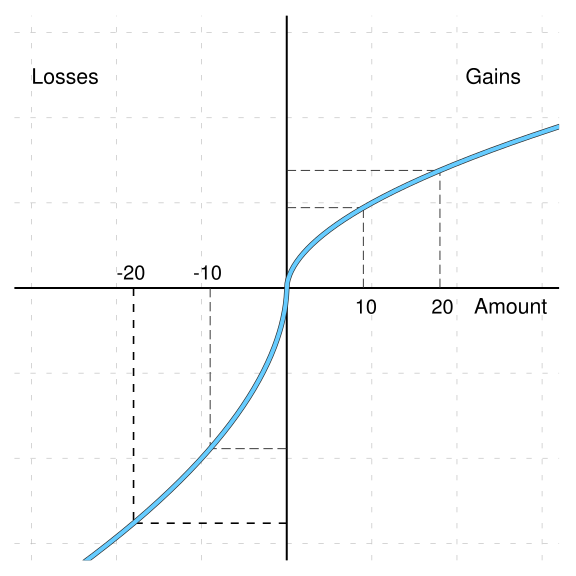
The first is evaluation relative to a reference point. Outcomes are not assessed in absolute terms but in relation to a baseline, typically the current state or a recent expectation. What falls above that reference point is experienced as a gain; what falls below it is experienced as a loss.
The second is diminishing sensitivity. Just as the utility of additional wealth diminishes at higher levels of wealth, the psychological impact of change diminishes as the change grows larger. The felt difference between gaining 90 and gaining 100 is considerably larger than the felt difference between gaining 990 and gaining 1,000, even though the absolute difference is the same in both cases.
The third is loss aversion. Losses and gains of the same magnitude are not experienced symmetrically; losses hit harder. When people are asked whether they would accept a gamble offering a 50% chance of losing 10 against a 50% chance of gaining 15, the positive expected value is not enough to make the gamble attractive to most. A useful way to measure the degree of loss aversion is to ask what minimum gain would be required to make such a gamble acceptable. For most people, the answer hovers around 20, roughly twice the potential loss, and the range across the population typically falls between 1.5 and 2.5 times the loss amount. Professional traders in financial markets tend to sit closer to the lower end of that range, having developed a greater tolerance for short-term fluctuations through sustained exposure and deliberate practice.
Prospect theory is not a standard fixture of introductory economics courses, and there is a reasonable argument for that choice. Classical economic theory, with its assumptions of rational preference and expected value maximization, provides adequate predictions across a wide range of situations. Introducing a competing framework that challenges those assumptions risks creating confusion before the baseline model is fully understood. Prospect theory earns its place in contexts where short-term emotional responses to gains and losses drive behavior in ways that long-term wealth calculations do not capture.
That said, prospect theory has its own boundaries. It handles the asymmetry between gains and losses well, but it does not naturally accommodate the emotions of regret and disappointment, which can play a significant role in how choices feel after the fact. Consider a gamble offering a 90% chance of winning a large sum versus a certainty of winning a small one. If the gamble is taken and lost, the disappointment is compounded by regret, the awareness that a safe and decent outcome was available and declined. Prospect theory assigns the same value to the gamble regardless of whether the certain alternative was 10 or 10,000, since both sit above the zero reference point, but the psychological experience of losing when a large sure gain was on the table is qualitatively different. The theory captures much of what standard economics misses; it does not capture everything.
Endowment effect
A standard concept in classical economics is the indifference curve. Each point along one of these curves represents a combination of goods that the individual finds equally desirable, and the convex shape of the curves reflects diminishing marginal utility: the more of a good one already possesses, the less additional value each new unit provides. By definition, every point on a given curve is equally attractive, and there is no rational incentive to move from one position to another along the same curve.
What this framework does not capture is the role of the current reference point. Indifference curves implicitly assume that utility at any given moment is determined entirely by the present situation, with no influence from past states or prior ownership. In many practical situations, that assumption breaks down, and its absence is precisely what prevents classical theory from fully explaining the endowment effect: the robust tendency for people to value something they already own considerably more than its market price would suggest.
The phenomenon is easy to illustrate. Suppose we are willing to pay up to 15 for a item. We acquire it at a price of 10. Shortly afterward, we find that we are unwilling to sell it at 20, and the price at which we would consider parting with it keeps rising. Nothing about the item has changed; only our relationship to it has.
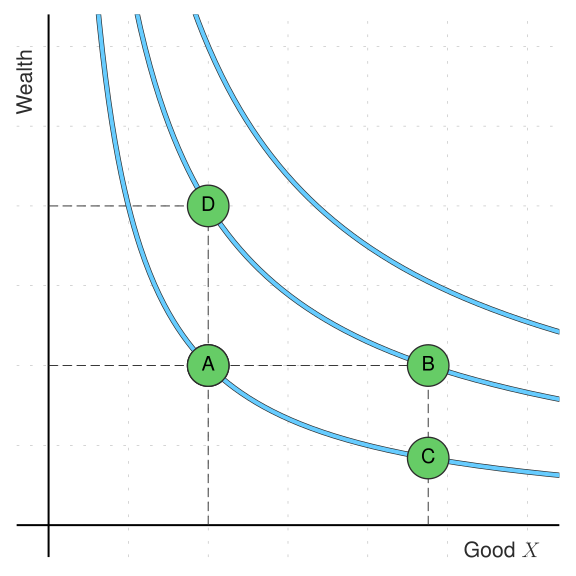
Both classical economics and prospect theory offer accounts of why this happens, and they arrive at the same qualitative conclusion by different routes. Within the expected utility framework, the asymmetry can be traced through indifference curves: the amount a person is willing to pay to acquire a good, measured as the distance between two points on adjacent curves (the segment B-C), is systematically smaller than the amount they would need to receive to willingly give up the same good (segment D-A). The geometry of the curves, combined with the curvature that reflects diminishing marginal utility, produces a gap between willingness to pay and willingness to accept even without invoking any psychological asymmetry.
Prospect theory offers a more direct and intuitive explanation. Because people evaluate outcomes relative to a reference point, and because losses loom larger than equivalent gains, giving something up is inherently more painful than acquiring it is pleasurable. The utility function is steeper on the loss side than the gain side, which means that parting with a good that one already owns registers as a loss, while acquiring the same good registers only as a gain. The pain of giving outweighs the pleasure of getting, and the price required to compensate for that pain rises accordingly.
The endowment effect is not, however, universal. It does not apply equally to all goods in all contexts. The relevant distinction is between items held for exchange and items held for use. Money, tokens, and goods acquired specifically for trading purposes do not typically trigger the effect, because the anticipated transaction is already built into how we hold them. Experiments using neutral tokens as the tradeable object show that participants behave largely in accordance with standard supply and demand dynamics. But when the objects carry even a modest suggestion of personal use, such as a pen or a mug, the endowment effect emerges: people consistently demand roughly twice as much to sell as they would be willing to pay to buy. This gap maps closely onto the loss aversion ratios identified by prospect theory.
The effect can be reduced, and the behavior of experienced traders offers a useful model. When the same exchange experiment is conducted with veteran traders, the gap narrows. They trade approximately half the time, close to the rate that would be expected if the endowment effect were absent. The difference in their behavior appears to stem from the question they are implicitly asking themselves: not “how much do I want to keep this?” but “how much do I actually want this item relative to what else I could have instead?” That change removes the sense of loss from the equation and places the decision back onto a straightforward comparison of value. It is a habit of mind, which suggests that while the endowment effect runs deep, it is not entirely beyond our capacity to correct for it.
Fourfold pattern
One of the structures developed in prospect theory is the fourfold pattern, a matrix that organizes human attitudes toward risk across two dimensions: whether the probability of an outcome is high or low, and whether that outcome represents a gain or a loss. Before examining each quadrant, it helps to understand the two psychological effects that give the pattern its characteristics.
The first is the possibility effect. When the probability of an event moves from zero to even a very small number, say five percent, something significant shifts in how people perceive it. An outcome that was simply impossible has become possible, and that transition receives a weight in the mind that far exceeds what the small probability would justify. The event is no longer ruled out, and that fact alone elevates its perceived significance disproportionately. The popularity of lotteries is a direct expression of this effect. People pay considerably more for a ticket than its expected value warrants, not because they have miscalculated the odds, but because the mere possibility of a large prize carries an emotional weight that the actual probability does not support.
The second is the certainty effect. As probability approaches one hundred percent, a parallel distortion operates in the opposite direction. Outcomes that are highly probable but not quite certain are systematically underweighted relative to their actual likelihood. People give less credit to a ninety percent chance than the number merits, which is why a sure settlement can be more attractive than a statistically superior gamble, even when the expected value of accepting the gamble is higher. The certain outcome commands a premium that its probability alone does not justify.
Together, these two effects mean that the decision weights people actually use are systematically different from objective probabilities. At the lower end of the probability scale, unlikely events are overweighted considerably: a two percent probability may function psychologically more like ten percent. At the upper end, the reverse applies: a two percent chance of losing something reduces perceived utility by closer to thirteen percent, far more than the raw probability would suggest. In the broad middle range, from roughly five to ninety-five percent, decision weights are compressed into a narrower band spanning approximately fifteen to eighty percent, about two thirds of the range that rational probability-weighting would produce. At the extremes, very low probabilities, around one percent or below, may be either ignored entirely or dramatically overweighted, with little sensitivity to the difference between, say, one in a thousand and one in a million.
Because people assign decision weights that diverge systematically from actual probabilities, they cannot fully conform to the prescriptions of expected utility theory, and their choices will contain predictable inconsistencies as a result.
Turning to the four quadrants themselves, each describes a distinct combination of attitude and behavior.
In the quadrant of high probability and gains, classical utility theory is on solid ground. People here are risk averse. They fear disappointment, they underweight the high but imperfect probability of winning, and they are willing to accept a guaranteed amount below the expected value of a favorable gamble in order to secure certainty. The psychological premium placed on a sure outcome leads them to leave expected value on the table.
The quadrant of high probability and losses is where behavior becomes counterintuitive. Rather than accepting a settlement that would limit their losses, people here tend to become risk seeking. They are reluctant to accept a sure loss, even a modest one, and will gamble on the possibility of avoiding it altogether, even when the gamble carries an inferior expected outcome. Two mechanisms reinforce each other here. Diminishing sensitivity means that a loss of nine feels only marginally less severe than a loss of ten, not the ninety percent as intense that a proportional assessment would suggest. And because high probabilities are underweighted, a ninety percent chance of a large loss is perceived as though it were closer to seventy percent, which makes the risk feel more manageable than it is. The combined effect is that people choose to gamble on a potentially larger loss rather than accept a smaller certain one, a tendency that frequently turns containable setbacks into serious damage.
The quadrant of low probability and gains is the natural home of the lottery. People overestimate the significance of a small but nonzero chance of a large prize, drawn more by the size of what could be won than by any realistic assessment of the probability of winning it. Having no ticket means having no chance; having one ticket means having a chance, and that distinction matters far more psychologically than the actual odds involved.
The quadrant of low probability and losses is the domain of insurance. People are willing to pay considerably more than the fair premium to protect themselves against unlikely but serious losses. The small probability of a bad outcome is overweighted, the prospect of that outcome generates disproportionate anxiety, and paying to eliminate the risk entirely feels worth the cost. This is, of course, the economic foundation on which insurance companies operate: the certainty effect on the demand side, and the law of large numbers on the supply side.
Rare events
Our ability to assess the probability of rare events is poor, and the errors we make tend to run in a consistent direction: we overestimate how likely unlikely events are, and we give them more weight in our decisions than their actual probability. These are two related phenomena, both rooted in the same underlying mechanisms of confirmation bias and cognitive ease.
When a rare event is associated with a vivid or emotionally charged image, the distortion intensifies. The probability of being caught in a terrorist attack is objectively very small, yet the mental images such events produce are quite powerful, generating associations that trigger impulses toward self-protection far out of proportion to the actual risk. The same mechanism operates with lotteries. The chance of winning a large prize is negligible, but purchasing a ticket is rewarded with a stream of agreeable fantasies, and it is those fantasies, not the probability, that drive the decision.
This overestimation is compounded when the alternatives to an event are left unspecified. In studies where fans were asked to estimate the probability of each team winning a playoff, listing the teams one by one, the individual estimates summed to well above one hundred percent, a logical impossibility that went unnoticed. Without a frame that makes the full set of alternatives visible, the mind evaluates each possibility in relative isolation.
A related bias is denominator neglect: the tendency to fix attention on the number of cases in which something happens while failing to consider the total number of cases in which it could happen. Describing a risk as affecting one person in one hundred thousand feels more alarming than expressing the same risk as a probability of 0.001 percent, even though the two statements are identical. Frequency formats, which describe risk in terms of counts rather than abstract percentages, are processed more vividly and carry more psychological weight, regardless of whether the underlying probability is actually higher.
Risk policies
Prospect theory establishes that people are generally risk averse when contemplating gains and risk seeking when facing losses: they will accept a lower expected value in exchange for certainty on the upside, and they will gamble on a larger potential loss to avoid accepting a smaller one as certain. These tendencies, well-documented in individual choices, become more expensive when they operate across a series of decisions.
When multiple decisions need to be made, there are two broad ways to approach them. Narrow framing treats each decision as a separate, self-contained problem. Broad framing considers the full set of decisions together, evaluating the combined range of possible outcomes as a single portfolio. By nature, people are narrow framers. Even when asked explicitly to consider a set of choices together, they tend to process them sequentially, and logical consistency across the full set is rarely achieved.
Broad framing, however, is considerably more effective when applied to investments. A collection of independent bets, each with a positive expected value, will produce occasional losses but a positive return on average over time. The key conditions are that the individual investments should be independent of one another, rather than correlated through exposure to the same underlying risks; that the potential loss on any individual position should not threaten overall financial security; and that the approach should not be applied to situations where the probability of profit is low.
Experienced traders operate on something close to these principles every day. The combination of loss aversion and narrow framing, by contrast, is costly over time. When each investment is treated as a standalone decision, every small loss registers with emotional force, and the natural response is to intervene and adjust. Checking a portfolio daily is, in this sense, a losing strategy: the frequency of negative feedback, amplified by loss aversion, generates far more pain than the equivalent positive feedback generates pleasure. Reviewing investments once every few weeks or once a quarter produces better decisions and better outcomes, partly because it reduces the emotional noise and partly because it encourages the broader view that the underlying logic requires.
Keeping score
The motivations behind financial behavior are not as straightforwardly economic as classical theory assumes. Once basic material needs are met, money tends to function more as a measure of self-regard and achievement than as a resource to be optimized in isolation. The rewards and penalties that drive financial decisions are largely psychological, and they operate through a system of mental accounts that people maintain, often without being fully aware of doing so.
People hold money in mentally distinct categories, each with its own emotional character and its own threshold for withdrawal. This mental accounting is a form of narrow framing applied to personal finance, a way of making a set of financial facts manageable for a mind of limited capacity. The problem is that these accounts introduce distortions. Classical economics holds that a cost already incurred should have no bearing on a forward-looking decision, since the past cannot be changed and only future outcomes are relevant. In practice, people routinely look backward when deciding what to do next, influenced by what they have already spent, lost, or committed.
One of the expressions of this is the disposition effect: the tendency to sell investments that have risen in value while holding on to those that have fallen. Each stock occupies a separate mental account, and people feel a strong pull toward closing every account in profit. A rational approach would integrate all holdings into a single view, account for tax implications, assess the future prospects of each position on its own merits, and sell whichever is least likely to perform going forward, regardless of whether it currently shows a gain or a loss. In practice, research consistently finds the opposite behavior. This is compounded by the fact that selling a losing position often makes better sense on two additional grounds: the tax treatment of realized losses can be advantageous, and there is evidence that short-term price momentum tends to persist briefly, meaning recent winners are statistically more likely to continue outperforming recent losers in the near term.
A related distortion is the sunk-cost fallacy: the tendency to continue investing time, money, or effort into a losing position because of what has already been committed, even when better alternatives are available. The past investment becomes a reason to persist, rather than an irrelevant past experience that should have no bearing on the current decision.
Through all of these patterns is present the emotion of regret. People are aware that they are prone to regretting their choices, and the anticipation of regret shapes decisions before they are made. Regret is triggered when an outcome could easily have been otherwise, particularly when it results from an active choice rather than from inaction. An unusual decision that leads to a bad outcome generates more regret than a conventional one with an identical result. This asymmetry consistently nudges behavior toward the familiar and expected path, even when a less conventional choice carries a superior expected outcome. The fear of future regret acts as an invisible tax on originality.
Two selves
The word “utility” carries two distinct meanings. The first meaning, which we can call experienced utility, refers to the moment-to-moment reality of pleasure and pain as we live through it. The second, decision utility, is the meaning more familiar to economists: it describes what people want, the preferences that drive their choices. These two notions coincide only under a specific assumption, that people accurately want what they will actually enjoy, and that they choose accordingly.
This is the assumption of rationality that underlies much of classical economic theory: that agents make decisions which serve their own interests. When experienced and decision utility diverge, however, people end up choosing things that do not serve them well, even by their own subsequent judgment.
The relationship between experienced utility and memory has been studied directly, with results that are difficult to reconcile with any simple notion of a rational, self-aware agent. In studies involving patients undergoing painful medical procedures, researchers identified two patterns. The first is the peak-end rule: a person’s overall rating of how painful an experience was can be predicted by combining just two data points, the intensity of pain at its worst moment and the intensity of pain at the very end. The second is duration neglect: the total length of the procedure, and therefore the total amount of pain actually endured, has essentially no bearing on how the experience is remembered.
This creates a conflict of objectives in how painful procedures might be designed. If the goal is to minimize the pain that will be remembered, the ideal procedure is longer overall but ends gently, with a low-intensity final stretch that leaves a more favorable final impression, even if this means a greater total quantity of pain is endured along the way. If the goal is instead to minimize the actual pain experienced, moment to moment, as it happens, a shorter procedure with a higher peak is preferable, even though it will be remembered as worse. These two objectives point in opposite directions, and the choice between them is, in effect, a choice about which of two selves we are optimizing for.
This framing gives rise to the idea of two distinct selves inhabiting the same person: the experiencing self, which lives through each moment as it occurs, and the remembering self, which constructs a narrative account afterward and is the one that makes decisions about the future, including decisions about whether to repeat an experience. The remembering self is not a faithful reporter of what the experiencing self went through; it is an editor, working with a small number of salient data points and discarding the rest. Treating the verdict of the remembering self as though it were an accurate summary of lived experience is a cognitive illusion, since the actual experience, once it has passed, cannot be revisited or revised. Only the memory of it remains, and the memory follows its own rules.
This same dynamic extends beyond medical procedures and shapes how people evaluate entire periods of their lives. In one thought experiment, people were asked to imagine a life that was, on the whole, very happy, and then to imagine the same life with a few additional years appended at the end, years that were pleasant but less happy than what came before. Logic suggests that adding more years of net-positive experience to an already happy life should increase total well-being, simply by extending the sum. Yet people consistently rated the extended life as less happy overall, as the peak-end rule would predict.
The implications of this reach into how people plan and structure our lives day to day. The way vacations are designed, the emphasis placed on capturing a handful of memorable highlights, and the attention paid to how an experience concludes all reflect, often without our realizing it, a quiet deference to the remembering self over the experiencing self. We are, in a sense, planning our lives to produce good stories, not necessarily good moments, and the two are not always the same thing.
References
KAHNEMAN, Daniel, 2013. Thinking, Fast and Slow. 1st edition. New York: Farrar, Straus and Giroux. ISBN 978-0-374-53355-7.