Complex plane representation of quadrature components
In quantum optics and quantum mechanics, coherent states, also known as quasi-classical states, play a fundamental role as they closely mimic classical behavior while still adhering to quantum principles. These states, denoted as |\boldsymbol \alpha \rangle, are eigenstates of the annihilation operator and are described by a complex number \alpha.
\mathbf a | \boldsymbol \alpha \rangle = \alpha | \boldsymbol \alpha \rangle
This complex number, \alpha, can be expressed in polar form as \alpha = |\alpha| e^{i\varphi}, where |\alpha| represents the amplitude and \varphi the phase.
A useful way to visualize these quantum states is through the complex plane, where the horizontal axis corresponds to the quadrature component \mathbf Q and the vertical axis to \mathbf P. These quadrature components are defined in terms of the creation and annihilation operators \mathbf a^\dag and \mathbf a:
\begin{aligned} \mathbf Q & = \sqrt{\frac{\hbar}{2}} \left( \mathbf a + \mathbf a^\dag \right) \\ \mathbf P & = \sqrt{\frac{\hbar}{2}} \frac{\left( \mathbf a - \mathbf a^\dag \right)}{i} \end{aligned}
For a coherent state |\boldsymbol \alpha_1 \rangle with complex number \alpha_1 = |\alpha_1| e^{i\varphi_1}, the average values of the quadrature components are:
\begin{aligned} \langle \mathbf Q_1 \rangle & = \langle \boldsymbol \alpha_1 | \mathbf Q_1 | \boldsymbol \alpha_1 \rangle = \sqrt{2\hbar} \left| \alpha_1 \right| \cos (\varphi_1) \\ \langle \mathbf P_1 \rangle & = \langle \boldsymbol \alpha_1 | \mathbf P_1 | \boldsymbol \alpha_1 \rangle = \sqrt{2\hbar} \left| \alpha_1 \right| \sin (\varphi_1) \end{aligned}
These averages can be directly plotted in the complex plane. The real part of \alpha_1, scaled by \sqrt{2\hbar}, corresponds to the average value of \mathbf Q_1, and the imaginary part, also scaled by \sqrt{2\hbar}, corresponds to the average value of \mathbf P_1. Therefore, the complex number \alpha_1 effectively maps onto a point in this phase space representation.
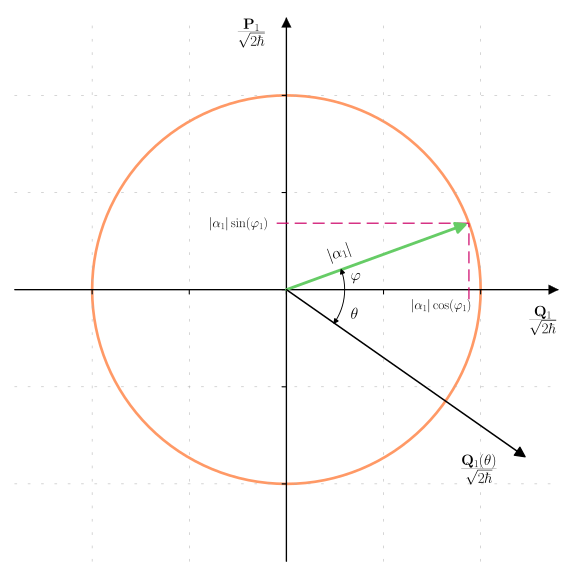
Considering a rotated quadrature \mathbf Q_\theta, associated with a phase \theta, its average value is given by:
\langle \mathbf Q_1(\theta) \rangle = \sqrt{2\hbar} \left| \alpha_1 \right| \cos (\varphi_1 - \theta)
This is equivalent to projecting the complex number \alpha_1 onto an axis rotated by an angle \theta from the \mathbf Q axis in the complex plane.
Now let’s examine the dispersion of these quadratures. For a coherent state, the variance of both \mathbf Q_1 and \mathbf P_1 is minimal and equal:
\Delta Q_1^2 = \Delta P_1^2 = \frac{\hbar}{2}
This leads to standard deviations of:
\Delta Q_1 = \Delta P_1 = \sqrt{\frac{\hbar}{2}}
This result is independent of the phase \theta, meaning that for any quadrature angle, the uncertainty remains constant. Consequently, the Heisenberg uncertainty principle, which states that \Delta Q_1 \Delta P_1 \geq \frac{\hbar}{2}, is saturated for coherent states:
\Delta Q_1 \Delta P_1 = \frac{\hbar}{2}
This demonstrates that quasi-classical states are minimum uncertainty states, achieving the lowest possible uncertainty product allowed by quantum mechanics. The complex plane representation offers a clear and intuitive way to understand these states and their fundamental quantum properties.
For more insights into this topic, you can find the details here.