Squeezed vacuum for quantum noise reduction
In order to achieve enhanced precision in quantum measurements, particularly within balanced interferometers, the concept of squeezed vacuum emerges as a promising field of research for reducing quantum noise. My recent work has focused on exploring the unique characteristics of squeezed vacuum states and their potential to surpass the standard quantum noise limit.
Unlike ordinary vacuum, squeezed vacuum exhibits tailored fluctuations in its quadrature components. Specifically, \mathbf P_{\lambda}-squeezed vacuum, visualized in the complex plane, can be engineered to possess reduced fluctuations in the \mathbf P_{\lambda} quadrature.
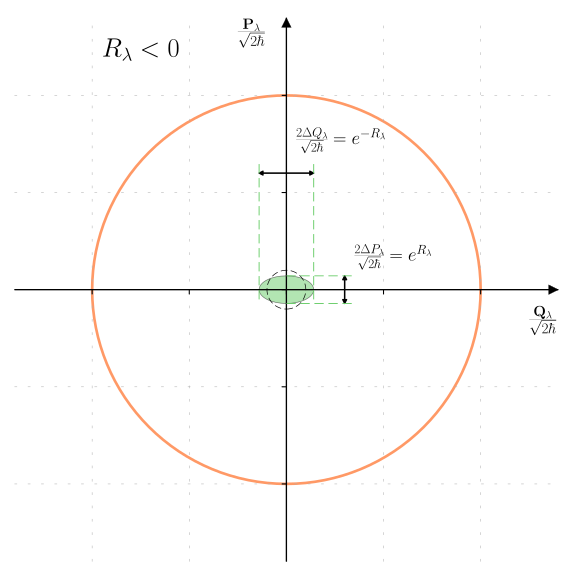
This is achieved by manipulating the vacuum state using a squeezing operator, characterized by a squeezing parameter R_\lambda.
Mathematically, \mathbf P_{\lambda}-squeezed vacuum | \mathbf 0, R_\lambda \rangle is defined by the annihilation operator \mathbf{A}_{R_\lambda} such that:
\mathbf{A}_{R_\lambda} | \mathbf 0, R_\lambda \rangle = 0
This squeezed vacuum state, despite having zero expectation values for both quadratures and the electric field, as shown by:
\begin{aligned} & \langle \mathbf 0, R_\lambda | \mathbf{E}_{\lambda}(\mathbf r,0) | \mathbf 0, R_\lambda \rangle = 0 \\ & \langle \mathbf 0, R_\lambda | \mathbf{Q}_{\lambda} | \mathbf 0, R_\lambda \rangle = 0 \\ & \langle \mathbf 0, R_\lambda | \mathbf{P}_{\lambda} | \mathbf 0, R_\lambda \rangle = 0 \end{aligned}
exhibits reduced variance in the \mathbf P_{\lambda} quadrature when R_\lambda is negative. The variance of \mathbf P_{\lambda} for squeezed vacuum is calculated to be:
\langle \mathbf 0, R_\lambda | \mathbf P_{\lambda}^2 | \mathbf 0, R_\lambda \rangle = \frac{\hbar}{2}e^{2R_\lambda}
This result indicates that for negative values of R_\lambda, the fluctuations of \mathbf P_{\lambda} can indeed be suppressed below the standard quantum limit, which corresponds to the variance of vacuum state (\hbar/2).
Furthermore, while maintaining the minimal uncertainty product \Delta Q_\lambda \Delta P_\lambda = \frac{\hbar}{2}, squeezed vacuum possesses a non-zero average photon number. The expectation value for the photon number operator \mathbf N_{\lambda} in the squeezed vacuum state is derived as:
\langle \mathbf 0, R_\lambda | \mathbf N_{\lambda} | \mathbf 0, R_\lambda \rangle = \sinh^2(R_\lambda)
This implies that even though the average field is zero, there is a detectable, albeit small, average photon number in squeezed vacuum, a characteristic distinct from ordinary vacuum. This subtle difference allows for the manipulation of quantum fluctuations to achieve noise reduction beyond classical limits.
By injecting \mathbf P_{\lambda}-squeezed vacuum into the input port of an interferometer, it becomes possible to reduce phase measurement fluctuations, paving the way for more sensitive and precise quantum measurements.
For more insights into this topic, you can find the details here.