Single photon polarization measurements
Quantum cryptography relies on the principle that measuring a single quantum system’s state with absolute precision is impossible. Consider a photon polarized at an angle \theta encountering a beam splitter aligned with the x-axis.
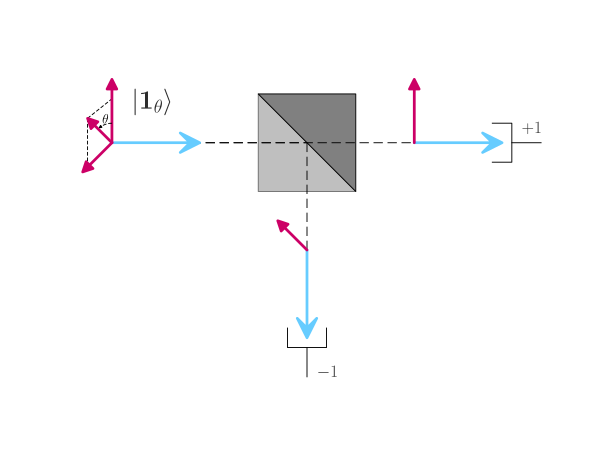
A single measurement yields either +1 or -1, but this outcome alone doesn’t reveal the initial polarization angle \theta. The photon’s state can be described as a superposition:
|\mathbf 1_\theta\rangle = \cos \left(\theta\right) |\mathbf 1_x\rangle + \sin \left(\theta\right) |\mathbf 1_y\rangle
This inherent uncertainty is at the heart of quantum security.
However, if I have access to many identically prepared photons, all polarized at the same angle \theta, the situation changes. By performing repeated measurements, I can statistically deduce the initial quantum state.
A basic approach is to conduct numerous measurements with a polarizer oriented along the x-axis. This allows me to estimate the probabilities of obtaining +1 or -1 outcomes:
\begin{aligned} & \mathcal P (+1) = \left|\langle \mathbf 1_x | \mathbf 1_\theta \rangle\right|^2 = \cos^2 \left(\theta\right) \\ & \mathcal P (-1) = \left|\langle \mathbf 1_y | \mathbf 1_\theta \rangle\right|^2 = \sin^2 \left(\theta\right) = 1 - \mathcal P (+1) \end{aligned}
Assuming linear polarization, these probabilities enable the determination of \pm \theta, modulo \pi:
\theta = \pm \arccos \left( \sqrt{\mathcal P (+1)} \right) + n\pi
The \pi ambiguity is not important for linear polarization because \theta and \theta + \pi represent the same direction. To resolve the sign ambiguity (positive or negative angle), I can perform an additional measurement with the polarizer in a non-collinear orientation.
For instance, if we suspect the polarization is at an angle +\theta, measuring with a polarizer at +\theta should consistently yield +1 outcomes. However, if the actual polarization is -\theta, measuring at +\theta will give a mix of +1 and -1 outcomes, with the probability of +1 being \cos^2(2\theta). This difference allows us to distinguish between +\theta and -\theta.
If the polarization is completely unknown and could be linear, circular, or elliptical, we can still determine its nature through multiple measurements, given a sufficient number of identically polarized photons.
For more insights into this topic, you can find the details here.