Quantum no-cloning theorem
Imagine a device that could perfectly duplicate quantum states, a quantum cloner. While seemingly straightforward, the laws of quantum mechanics impose a strict limit: the no-cloning theorem. This theorem states that creating an identical copy of an unknown quantum state is fundamentally impossible.
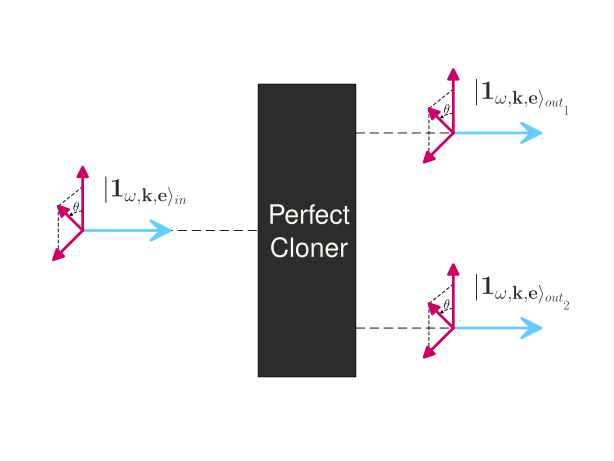
Why is this the case? Let’s consider polarized photons to understand this principle. A photon’s polarization can represent a qubit, the basic unit of quantum information. We can describe a photon polarized along an arbitrary direction \theta as a superposition of horizontal (x) and vertical (y) polarizations:
| \boldsymbol \Psi_{\text{in}} \rangle = |\mathbf 1_\theta\rangle = \cos \left(\theta\right) |\mathbf 1_x\rangle + \sin \left(\theta\right) |\mathbf 1_y\rangle
Now, let’s hypothesize a perfect quantum cloner. If such a device existed, it should produce two identical copies of any input photon polarization. For an input |\mathbf 1_\theta\rangle, the output should be |\mathbf 1_\theta\rangle_1 \otimes |\mathbf 1_\theta\rangle_2. Expanding this output, we get:
\begin{aligned} | \boldsymbol \Psi_{\text{out}} \rangle = & |\mathbf 1_\theta\rangle_1 \otimes |\mathbf 1_\theta\rangle_2 \\ = & \cos^2\left(\theta\right) |\mathbf 1_x,\mathbf 1_x\rangle + \cos\left(\theta\right)\sin\left(\theta\right)|\mathbf 1_x, \mathbf 1_y\rangle \\ & +\sin\left(\theta\right) \cos\left(\theta\right)|\mathbf 1_y, \mathbf 1_x\rangle + \sin^2\left(\theta\right)|\mathbf 1_y,\mathbf 1_y\rangle \end{aligned}
However, quantum mechanics dictates that the evolution of a quantum system must be linear. This means that if we have a superposition of inputs, the output must be the superposition of the corresponding outputs. If we consider the \theta-polarized photon as a superposition and apply linearity to our hypothetical cloner, we would expect the output to be:
\boldsymbol \Psi_{\text{out}} \rangle = \cos\left(\theta\right) |\mathbf 1_x, \mathbf 1_x\rangle + \sin\left(\theta\right) |\mathbf 1_y, \mathbf 1_y\rangle
Comparing the two expressions for |\boldsymbol \Psi_{\text{out}} \rangle, we see they are different. This discrepancy demonstrates a fundamental contradiction. The assumption of a perfect quantum cloner, combined with the linear nature of quantum mechanics, leads to inconsistent outcomes. Therefore, perfect quantum cloning of arbitrary states is impossible.
This no-cloning theorem is not just a theoretical curiosity; it ensures the security of quantum key distribution protocols, as it prevents an eavesdropper from intercepting and perfectly copying a quantum key without being detected. Furthermore, it has implications for our understanding of quantum information and the limits of manipulating quantum states.
It’s important to note that the no-cloning theorem applies to arbitrary quantum states. If we restrict ourselves to a specific, known quantum state, cloning becomes possible. For instance, if we know in advance that all photons are horizontally polarized, we can easily create a device that outputs two horizontally polarized photons, effectively “cloning” the known state. However, this does not violate the no-cloning theorem, which prohibits cloning of unknown quantum states.
For more insights into this topic, you can find the details here.