Hidden variable model for entanglement using photons pair
In my previous blog post here, I discussed the idea of hidden variables as a potential explanation for quantum entanglement, offering a deterministic and local alternative to the standard quantum mechanical interpretation. Now, I want to present a concrete example of such a hidden variable model and explore its predictions.
Let’s imagine that each pair of entangled photons, at the moment of emission, is characterized by a predetermined linear polarization angle, denoted by \lambda. This angle is the hidden variable. We assume that the outcome of a polarization measurement is not random, but fully determined by \lambda and the orientation of the polarizer.
For a polarizer oriented at an angle \mathbf a, we propose the measurement outcome function A(\lambda, \mathbf a) as:
A(\lambda, \mathbf a) = \operatorname{sgn}\left[ \cos(2(\mathbf a - \boldsymbol \lambda))\right]
Similarly, for a polarizer at angle \mathbf b, the outcome for the second photon is:
B(\lambda, \mathbf b) = \operatorname{sgn}\left[ \cos(2(\mathbf b - \boldsymbol \lambda))\right]
This function yields +1 if the photon’s polarization angle \lambda is within \pi/4 of the polarizer axis \mathbf a, and -1 otherwise. To model the observed randomness, I assume that \lambda varies across different photon pairs with a uniform probability distribution:
\rho(\lambda) = \frac{1}{2\pi}
With this model, we can calculate the probability of measuring +1 for a single photon with polarizer orientation \mathbf a:
\mathcal P_{+}(\mathbf a) = \int_0^{2\pi} \frac{1}{2\pi} \left\{\frac{1}{2}\left[ \operatorname{sgn}\left[ \cos(2(\mathbf a - \boldsymbol \lambda))\right] + 1\right] \right\}\mathrm d \lambda = \frac{1}{2}
This result, \mathcal P_{+}(\mathbf a) = \frac{1}{2}, is consistent with quantum mechanical predictions for single polarization measurements.
Now, let’s examine the correlation between measurements on entangled photon pairs. The correlation \mathcal C in this hidden variable model is given by:
\mathcal C = \int_0^{2\pi} \frac{1}{2\pi} \operatorname{sgn}\left[ \cos(2(\mathbf a - \boldsymbol \lambda))\right]\operatorname{sgn}\left[ \cos(2(\mathbf b - \boldsymbol \lambda))\right] \mathrm d \lambda
This correlation \mathcal C depends on the relative angle between the polarizers, \alpha = |\mathbf a - \mathbf b|. Plotting this correlation as a function of \alpha reveals a piecewise linear function. Interestingly, this model’s correlation matches the quantum mechanical prediction at specific angles, particularly when the correlation is either zero or maximal. However, discrepancies arise for intermediate angles.
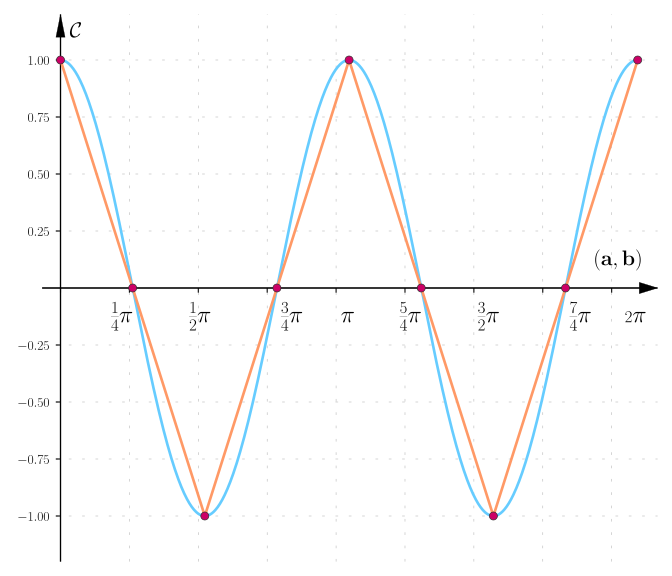
This simple hidden variable model demonstrates how deterministic outcomes, governed by a hidden parameter, can lead to statistical predictions that, in some aspects, resemble those of quantum mechanics. While this specific model does not perfectly reproduce all quantum correlations, it serves as a valuable illustration of the hidden variable concept and its potential to offer alternative descriptions of entanglement.
For more insights into this topic, you can find the details here.