Bell states |\boldsymbol \Psi^- \rangle and |\boldsymbol \Psi^+ \rangle measurements
Bell states form a fundamental concept in quantum information science, representing maximally entangled states of two qubits. For polarization-entangled photons, we have four Bell states, which constitute a complete orthogonal basis. Ideally, we would like to have an apparatus that can distinguish between all four Bell states, effectively performing a complete Bell measurement. However, constructing such a device is a significant experimental challenge.
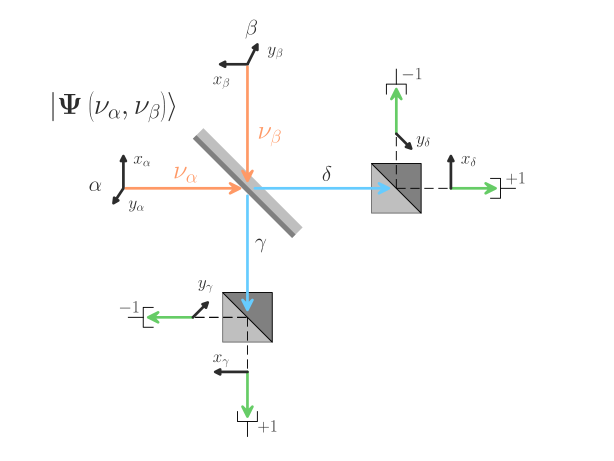
Instead, current technology allows for partial Bell measurements. These measurements are designed to detect the presence of at least one specific Bell state. Let’s consider an apparatus based on a simple beam splitter, designed to perform a measurement associated with the Bell state |\boldsymbol \Psi^-\rangle. This state, also known as the singlet state, is given by:
|\boldsymbol \Psi^-(\nu_1, \nu_2)\rangle = \frac{1}{\sqrt{2}} \left( |\mathbf x_1, \mathbf y_2\rangle - |\mathbf y_1, \mathbf x_2\rangle \right)
where |\mathbf x_1, \mathbf y_2\rangle denotes photon 1 with \mathbf x polarization and photon 2 with \mathbf y polarization.
By analyzing the behavior of this state when photons \nu_\alpha and \nu_\beta enter a beam splitter, we can understand how the apparatus works. Using the beam splitter relations for creation operators, we can express the input state in terms of the output modes \gamma and \delta. After some algebra, we find that the Bell state |\boldsymbol \Psi^-\rangle in the output space becomes proportional to:
|\boldsymbol \Psi^-(\nu_\gamma, \nu_\delta)\rangle \propto \left( |\mathbf y_\gamma, \mathbf x_\delta\rangle - |\mathbf x_\gamma, \mathbf y_\delta\rangle \right)
This expression indicates that a measurement of |\boldsymbol \Psi^-(\nu_\alpha, \nu_\beta)\rangle can be achieved by detecting joint photon counts in output channels \gamma and \delta with orthogonal polarizations. Specifically, we look for events where detector in mode \delta clicks for \mathbf x polarization and detector in mode \gamma clicks for \mathbf y polarization, or vice-versa.
Now, let’s consider the first Bell state |\boldsymbol \Psi^+\rangle:
|\boldsymbol \Psi^+(\nu_1, \nu_2)\rangle = \frac{1}{\sqrt{2}} \left( |\mathbf x_1, \mathbf y_2\rangle + |\mathbf y_1,\mathbf x_2\rangle \right)
Following a similar derivation using beam splitter relations, we find that in the output space, |\boldsymbol \Psi^+\rangle becomes proportional to:
|\boldsymbol \Psi^+(\nu_\gamma, \nu_\delta)\rangle \propto \left( |\mathbf x_\gamma, \mathbf y_\gamma\rangle - |\mathbf x_\delta, \mathbf y_\delta\rangle \right)
In this case, the apparatus signals a detection when we observe joint counts of both polarizations (\mathbf x and \mathbf y) in channel \gamma, or joint counts of both polarizations in channel \delta. Crucially, these two outcomes are mutually exclusive.
In summary, this simple beam splitter setup, combined with polarization measurements, allows us to perform partial Bell measurements, specifically distinguishing the |\boldsymbol \Psi^-\rangle and |\boldsymbol \Psi^+\rangle Bell states based on distinct detection patterns in the output channels. This is a fundamental step towards more complex quantum information processing tasks.
For more insights into this topic, you can find the details here.