Complex numbers: representation and algebra
Complex numbers extend the real number system by introducing the imaginary unit i, defined by i^2 = -1. Every complex number z can be written in algebraic form as z = x + iy, with x and y real, where x is the real part (\Re(z)) and y is the imaginary part (\Im(z)).
We can represent complex numbers in the complex plane using the real part along the horizontal axis and the imaginary part along the vertical axis. This identification enables a natural geometric visualization of z either as a point or as a vector from the origin to (x, y).
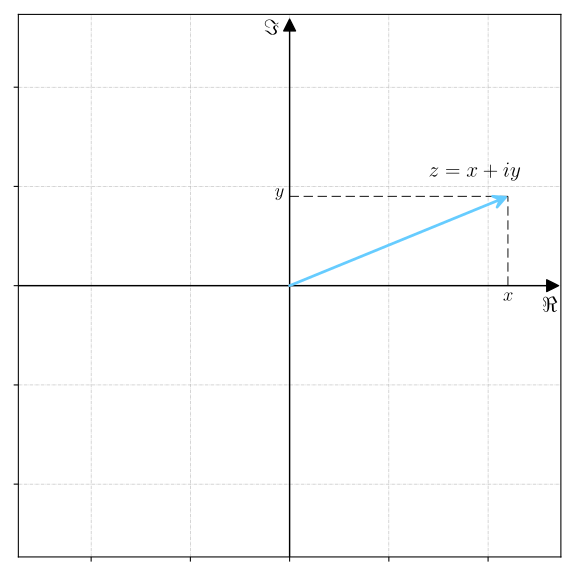
Addition of two complex numbers corresponds to vector addition, while multiplication involves both scaling and rotation. For example, multiplying by i rotates a vector by \frac{\pi}{2} counterclockwise. The polar form of a complex number uses its modulus r and argument \theta, where
r = |z| = \sqrt{x^2 + y^2}
and:
\theta = \arg(z)
so:
z = r (\cos\theta + i \sin\theta) = r e^{i\theta}
via Euler’s formula.
Complex conjugation is another essential operation. For z = x + iy, its conjugate is \bar{z} = x - iy. This operation reflects z across the real axis in the complex plane and satisfies:
z \cdot \bar{z} = |z|^2
We can extract real and imaginary parts from z using:
\Re(z) = \frac{z + \bar{z}}{2},\quad \Im(z) = \frac{z - \bar{z}}{2i}
Multiplication and division are often handled efficiently in polar form. If z_1 = r_1 e^{i\theta_1} and z_2 = r_2 e^{i\theta_2}, then:
z_1 z_2 = r_1 r_2 e^{i(\theta_1 + \theta_2)}
and:
\frac{z_1}{z_2} = \frac{r_1}{r_2} e^{i(\theta_1 - \theta_2)}
Addition and multiplication of complex numbers are commutative, associative, and distributive, preserving algebraic structure on \mathbb{C}.
For more insights into this topic, you can find the details here.