Complex power functions and polynomials
Complex analysis brings forward a class of entire functions known as power functions, represented for non-negative integers n by f(z) = z^n where z \in \mathbb{C}. When n = 0, f(z) = 1 for any z, including z = 0. For n \ge 1, the function corresponds to multiplying z by itself n times, and the result stays analytic throughout the complex plane.
These functions take an easy form to compute when represented in polar coordinates. For z = r e^{i\theta}, one finds:
z^n = (r e^{i\theta})^n = r^n e^{in\theta}
Using Euler’s formula gives:
z^n = r^n [\cos(n\theta) + i \sin(n\theta)]
This highlights that the modulus is raised to the n-th power while the argument is multiplied by n. The point z maps to a new point whose distance from the origin is r^n and whose angle is n\theta, a geometric transformation clear through this representation.
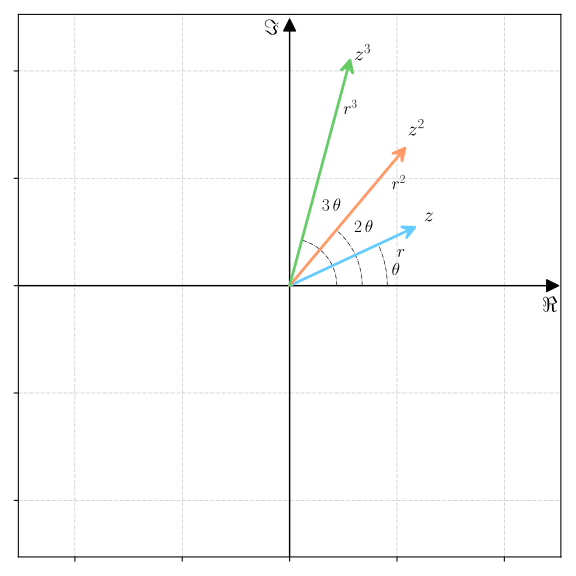
Single-valuedness of z^n for integer n \ge 0 comes from the periodicity of the exponential: shifting the argument by 2\pi multiples does not affect the outcome since e^{in2k\pi} = 1 for integer n and z^n remains uniquely defined across the plane.
Polynomials extend this concept to finite linear combinations:
P(z) = \sum_{k=0}^n a_k z^k
with complex coefficients a_k. These functions are also entire and preserve analyticity.
When extending the idea of exponentiation to negative integers, z^{-n} is well-defined for z \neq 0, and more generally, expressions like z^c with arbitrary complex c bring in multivalued behavior. For non-integer exponents, it becomes necessary to define branches and branch cuts, as z^{1/n} possesses n distinct values other than zero.
For more insights into this topic, you can find the details here.