Complex rational powers
When raising a complex number z to a rational exponent a = m/n, the resulting function is multivalued and directly connected to the theory of complex logarithms. The general form uses the exponential and logarithmic identities for complex numbers:
z^a = z^{m/n} = e^{\frac{m}{n} \operatorname{Log}(z)}
where \operatorname{Log}(z) denotes the multivalued complex logarithm. Writing z = r e^{i\theta_p} with r = |z| and principal argument -\pi < \theta_p \le \pi, the n distinct values of z^{m/n} are:
(z^{m/n})_k = r^{m/n} \exp\left[i\left(\frac{m}{n}(\theta_p + 2\pi k)\right)\right], \quad k = 0, 1, \dots, n-1.
Each branch corresponds to a different k, with the principal value obtained by k=0:
\operatorname{PV}(z^a) = r^a e^{ia\theta_p}
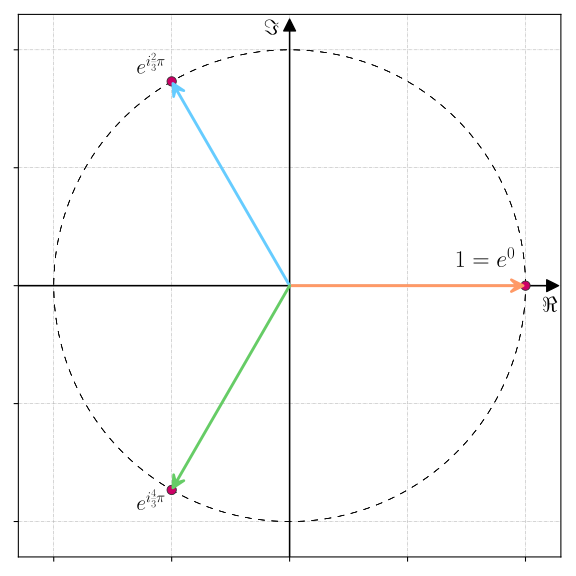
For z=1, this formula gives the n-th roots of unity, placed evenly around the unit circle:
\omega_k = e^{i\frac{2\pi k}{n}}, \quad k = 0, 1, ..., n-1
These points can be interpreted as the vertices of a regular polygon inscribed in the unit circle of the complex plane.
If the exponent is not rational, the number of branches becomes infinite due to the non-periodic behavior of e^{ia 2\pi k} for irrational or general complex a.
For more insights into this topic, you can find the details here.