Proof of Cauchy-Goursat theorem
The theorem asserts that for any open subset \mathcal D of the complex plane, if f is holomorphic on \mathcal D, then the integral over any closed triangular contour T with interior in \mathcal D is zero:
\oint_T f(z) \mathrm{d}z = 0
The proof introduces a sequence of nested triangles, starting from T, with each triangle subdivided by bisecting its sides to form four congruent, similar sub-triangles.
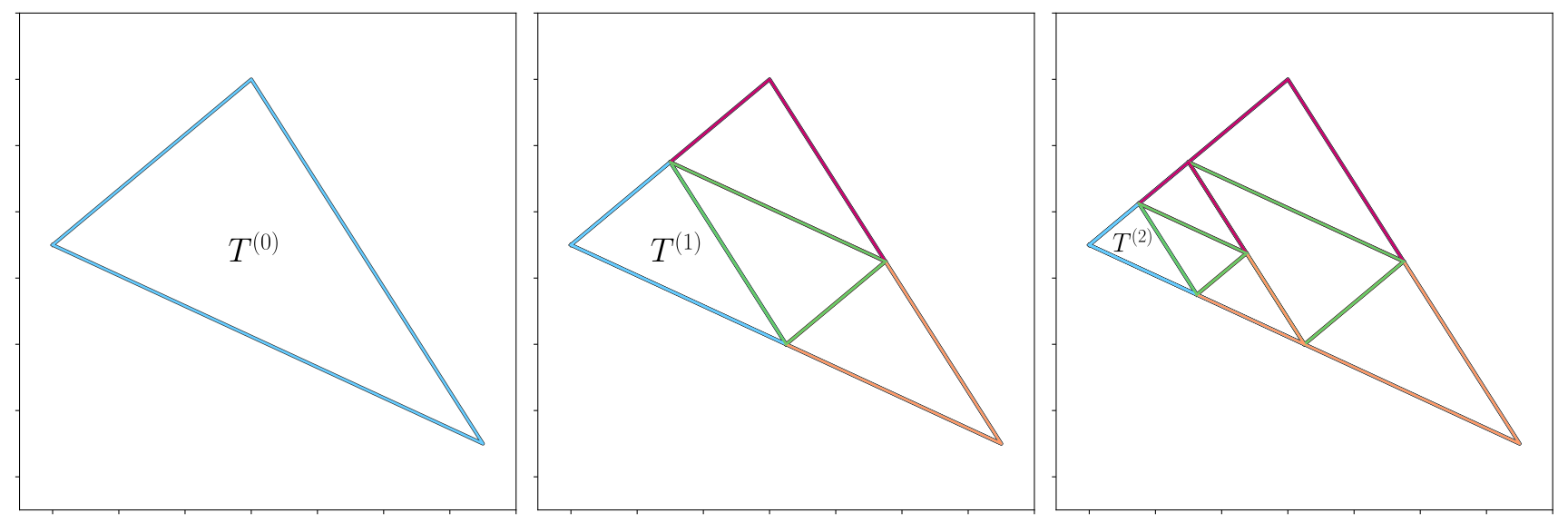
Summing the integrals over these smaller triangles reproduces the integral over the original T. Applying the triangle inequality, at least one triangle in each iteration must have at least a quarter of the integral’s magnitude, and this process is repeated recursively, yielding a sequence T^{(n)} shrinking to a point z_0.
The structure of holomorphic functions enables a linear approximation around z_0:
f(z) = f(z_0) + f'(z_0) (z - z_0) + \psi(z)(z - z_0)
where the remainder \psi(z) satisfies:
\lim_{z \to z_0} \psi(z) = 0
The terms f(z_0) and f'(z_0) (z - z_0) integrate to zero over any closed contour, so only the error term remains.
By the ML-inequality, the contour integral over T^{(n)} is bounded:
\left| \oint_{T^{(n)}} f(z) \mathrm{d}z \right| \le \varepsilon d^{(n)} p^{(n)}
where d^{(n)} and p^{(n)} are the diameter and perimeter, both scaling by 2^{-n}.
Therefore, the bound:
\left| \oint_T f(z) \mathrm{d}z \right| \le \varepsilon d^{(0)} p^{(0)}
shows that the integral can be made arbitrarily small, so it must vanish.
For more insights into this topic, you can find the details here.