Complex integration and the fundamental theorem of calculus
Understanding the properties of contour integrals for analytic functions is central to complex analysis.
For any analytic function f(z), the value of its integral along a contour depends solely on the endpoints, not on the specific path, provided the domain is simply connected and f(z) is analytic throughout.
Consider a complex function f(z) = u(x, y) + i v(x, y), where u and v represent the real and imaginary parts.
If C is a contour connecting z_0 to z_1, the integral along C can be written as:
\int_C f(z)\,\mathrm{d}z = \int_C (u + i v)(\mathrm{d}x + i\,\mathrm{d}y) = \int_C [(u\,\mathrm{d}x - v\,\mathrm{d}y) + i (v\,\mathrm{d}x + u\,\mathrm{d}y)]
If f(z) is analytic within a region containing the paths, the Cauchy-Goursat theorem states that the contour integral around any closed contour is zero:
\oint_{C} f(z)\,\mathrm{d}z = 0
This result implies that integrals along different contours connecting the same endpoints yield the same value.
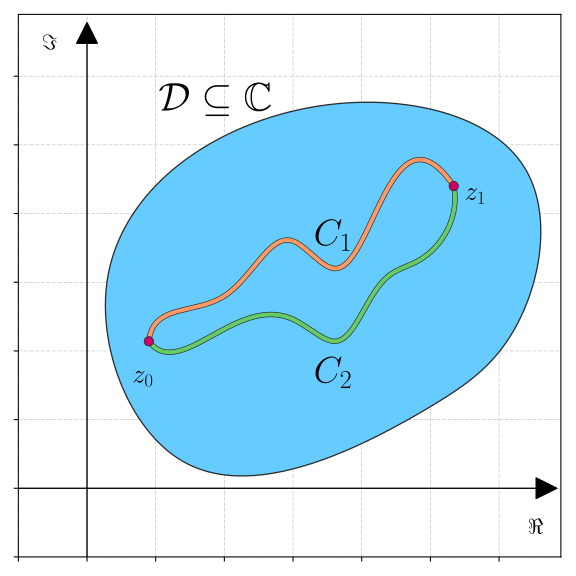
The key consequence is path independence, paralleling properties observed in conservative vector fields.
Beyond path independence, complex analysis offers a direct analogue of the fundamental theorem of calculus. If f(z) has an antiderivative F(z) in the region of interest, the contour integral from z_0 to z_1 is simply:
\int_C f(z)\,\mathrm{d}z = F(z_1) - F(z_0)
This principle is powerful: once an antiderivative is known, the integral follows directly, avoiding explicit parametrization or computation along the path.
For more insights into this topic, you can find the details here.