Bell’s inequalities: challenging local realism
I revisit Bell’s theorem, a concept I previously explored here, and its mathematical pformulation through Bell’s inequalities. These inequalities proof the conflict between quantum mechanics and classical intuitions about reality.
Bell formalized Einstein’s notion of local realism by introducing hidden variables, denoted as \lambda. These variables are assumed to determine the outcomes of measurements, even in quantum systems. In the context of photon polarization measurements, we can represent these outcomes by functions A(\mathbf a, \lambda) and B(\mathbf b, \lambda), where \mathbf a and \mathbf b are the orientations of polarizers.
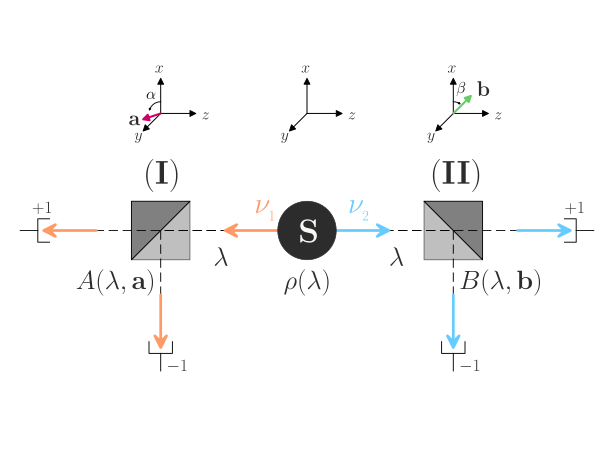
Locality means that the first measurement outcome A depends only on their polarizer orientation \mathbf a and the hidden variable \lambda, and similarly, the second outcome B depends only on \mathbf b and \lambda. The distribution of hidden variables \rho(\lambda) is assumed to be independent of the polarizer settings. The correlation between the first and second measurements is then given by the average product of their outcomes:
\mathcal C(\mathbf a, \mathbf b) = \int \rho(\lambda) A(\lambda, \mathbf a) B(\lambda, \mathbf b) \mathrm d \lambda
To derive Bell’s inequality, let’s consider the quantity S for a specific hidden variable \lambda and four polarizer orientations \mathbf a, \mathbf a^\prime, \mathbf b, and \mathbf b^\prime:
\begin{aligned} S = & A(\lambda, \mathbf a) B(\lambda, \mathbf b) - A(\lambda, \mathbf a) B(\lambda, \mathbf b^\prime) \\ & + A(\lambda, \mathbf a^\prime) B(\lambda, \mathbf b) + A(\lambda, \mathbf a^\prime) B(\lambda, \mathbf b^\prime) \end{aligned}
Since A and B can only take values \pm 1, it can be shown that S is always equal to \pm 2. Consequently, the average value of S over all possible values of \lambda is bounded:
\left|\int \rho(\lambda) S(\lambda) \mathrm d \lambda \right| \le 2
This inequality, when expressed in terms of correlation coefficients, becomes:
\left| \mathcal C(\mathbf a, \mathbf b) - \mathcal C(\mathbf a, \mathbf b^\prime) + \mathcal C(\mathbf a^\prime, \mathbf b) + \mathcal C(\mathbf a^\prime, \mathbf b^\prime) \right|\le 2
This is Bell’s inequality. It must hold if local realism is valid.
However, quantum mechanics predicts correlations that can violate this inequality. For example, considering specific angles between the polarizer orientations, and using the quantum mechanical prediction for correlation \mathcal C(\mathbf a, \mathbf b) = \cos(2(\mathbf a, \mathbf b)), we find that Bell’s inequality can be violated. For instance, with (\mathbf a, \mathbf b) = \frac{\pi}{8}, (\mathbf a, \mathbf b^\prime) = \frac{3\pi}{8}, (\mathbf a^\prime, \mathbf b) = \frac{\pi}{8}, and (\mathbf a^\prime, \mathbf b^\prime) = \frac{\pi}{8}, the quantum prediction yields a value of 2\sqrt{2}, which is greater than 2.
Experiments have been conducted to test Bell’s inequalities. Early experiments and more sophisticated ones, such as the Orsay experiment in 1982 which enforced locality by fast switching of polarizers, have consistently shown violations of Bell’s inequalities. These results are in agreement with quantum mechanics and challenge the idea of local realism.
The violation of Bell’s inequality suggests that at least one of the assumptions of local realism must be incorrect. This has profound implications for our understanding of quantum mechanics, suggesting that either locality or realism, as classically understood, does not hold in the quantum world. While some might find these implications conceptually challenging, experimental evidence supports the quantum mechanical view.
For more insights into this topic, you can find the details here.