Bell states: final considerations
I have already computed the single states in my post here and here, and now I summarize how joint photodetection can be used to discriminate specific Bell states.
For practical implementations, partial discrimination of these states is often necessary. A setup using beam splitters and photodetectors allows to distinguish between the | \boldsymbol \Psi^- \rangle and | \boldsymbol \Psi^+ \rangle states while leaving | \boldsymbol \Phi^+ \rangle and | \boldsymbol \Phi^- \rangle indistinguishable.
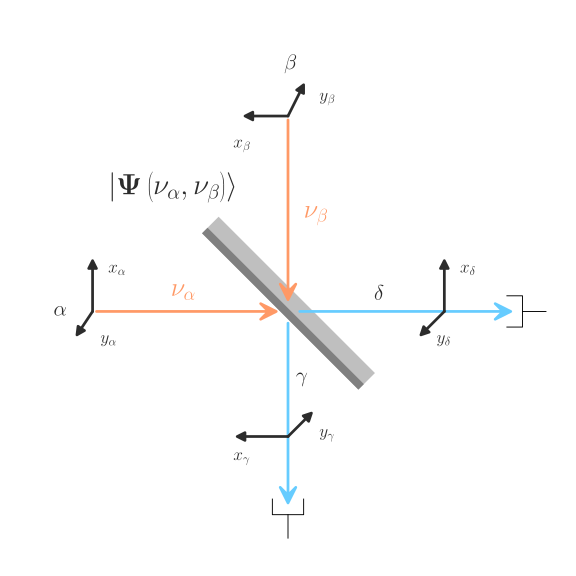
The ability to distinguish states relies on how photons behave when passed through a polarized beam splitter and subsequently detected:
- a coincidence detection across two separate detectors uniquely identifies | \boldsymbol \Psi^- \rangle,
- a joint detection in a single output channel corresponds to | \boldsymbol \Psi^+ \rangle,
- a two-photon detection at only one detector implies the presence of either | \boldsymbol \Phi^+ \rangle or | \boldsymbol \Phi^- \rangle but does not allow distinguishing between them.
This behavior emerges from the interactions of the Bell states with the beam splitter, and was described in my previous posts.
While partial Bell state measurement is feasible with linear optics, a full Bell measurement requires a quantum two-bit gate. This gate, relying on photon-photon nonlinearities, remains challenging to implement with current technology.
Despite this limitation, the ability to distinguish | \boldsymbol \Psi^- \rangle in an experiment has already enabled several quantum optics experiments. For example, joint detection methods play an important role in protocols like quantum teleportation, where partial Bell state knowledge is useful.
For more insights into this topic, you can find the details here.