Complex Taylor expansions
In complex analysis, many functions can be expressed locally using power series centered at a point z_0 \in \mathbb{C}:
\sum_{k=0}^\infty a_k (z - z_0)^k
For functions f(z) analytic at z_0, the Taylor series provides a unique power series representation in a disk centered at z_0. The Taylor coefficients are given by:
a_k = \frac{f^{(k)}(z_0)}{k!}
and the expansion is:
f(z) = \sum_{k=0}^\infty \frac{f^{(k)}(z_0)}{k!} (z - z_0)^k
A function is analytic on an open set if at every point it admits such a convergent series. In the complex setting, analyticity and holomorphicity are equivalent; a single complex derivative suffices to guarantee infinite differentiability and power series expansion.
Each power series is associated with a radius of convergence r that describes the largest disk, |z-z_0|< r, where the series converges. Inside this disk, convergence is absolute and uniform on compacta. The value of r corresponds to the distance from z_0 to the nearest singularity of f(z). For instance, entire functions, such as the exponential or sine and cosine, have r = \infty.
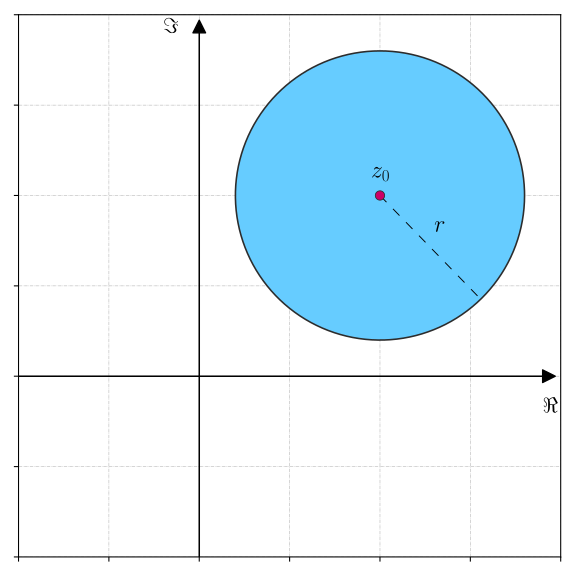
The Cauchy-Hadamard theorem gives an efficient means to find r:
r = \frac{1}{\limsup_{k\to\infty} \sqrt[k]{|a_k|}}
Alternatively, if the ratio
\lim_{k\to\infty} \left|\frac{a_{k+1}}{a_k}\right|
exists, the radius is
r = \lim_{k\to\infty} \left|\frac{a_k}{a_{k+1}}\right|
As an example, the power series for e^z is given by
e^z = \sum_{k=0}^\infty \frac{z^k}{k!}
and its radius of convergence is infinite, confirming analytic extension throughout \mathbb{C}.
For more insights into this topic, you can find the details here.